Evaluating Brand Context Layers on Whether Internal Agents Pull Live Guidance or Stale Snapshots
Agents following stale brand rules sound confident while delivering wrong guidance.

Giving internal agents accurate brand context requires a shared, versioned source of guidance that they query at inference time, with automatic updates and active staleness detection. Evaluating a brand context layer means testing that delivery architecture. An agent cannot reliably follow today’s brand strategy if its infrastructure supplies yesterday’s rules.
Why the agent's answer can be perfectly written and completely wrong
An agent generates a campaign email using voice rules from six months ago. The copy is fluent, and it follows the brief. But the brand changed its tone after a repositioning, and the agent’s guidance still reflects the old strategy. Nothing in the email exposes that mismatch. The error becomes visible only when someone compares the output with the current guidance, potentially after the campaign has shipped.
This failure differs from a broken pipeline. A pipeline error shows that something went wrong, while stale context can lead to an answer that sounds confident and makes sense but rests on last quarter’s positioning. A support agent or copy tool can follow every rule it was given and still give customers the wrong experience. Better wording in the prompt cannot fix this, because the missing information never reaches the model.
What "brand context layer" actually means as an infrastructure category
A brand context layer assembles and delivers brand guidance to agents at inference time. It is infrastructure. Its function is to supply the rules relevant to the task, while keeping those rules aligned with the current brand requires an architecture that supplies current guidance. The key distinction is between static and dynamic context.
Static context is knowledge loaded once, such as a system prompt, PDF export, or cached brand guide. It remains unchanged until someone refreshes it. Dynamic context is retrieved or assembled at inference time and shaped by the task. Production systems can use both, with stable governance instructions in static context and current intelligence in dynamic context. Evaluation must establish where the brand guidance resides.
Two-pass assembly makes that distinction easy to miss. A first pass loads static instructions and cached rules, while a second injects current task state and fresh retrieval. The second pass does not refresh the first. Brand guidance supplied only in the first pass remains static, even when the rest of the system responds to live information.
Retrieval-augmented generation, or RAG, introduces a related ambiguity. RAG retrieves document snapshots at query time, whereas a context engine maintains stateful, continuously updated business objects. Retrieval timing alone does not establish source freshness. An agent querying a brand guide last refreshed three months ago is using a dynamic delivery mechanism to retrieve static knowledge.
Why brand guidance is especially vulnerable to semantic staleness
Brand guidance can fall out of date even when no stored value has changed. After a repositioning, a tone rule may still exist in the knowledge store even though it no longer expresses the brand’s intended voice. The record remains intact, but its authority has ended. This is semantic staleness, rather than record-level staleness, where a database value changes and downstream data falls behind.
That difference limits what ordinary pipeline monitoring can detect. A successful retrieval shows that the agent accessed the stored rule. The old knowledge store can still work as it should after the logo usage policy or messaging hierarchy has changed. The agent has no independent visibility into the gap and treats the retrieved guidance as ground truth.
Missing ownership makes this problem harder to contain. Without a steward or version history, there may be no accountable record of whether a definition still applies. Staleness can then accumulate without a technical failure. Brand freshness therefore needs to be a monitored property of the context layer, rather than a calendar-driven audit that leaves intervening changes unaccounted for.
How most brand guidelines are structured today, and why that structure is the problem
Most brand guidelines live in PDFs or Google Docs designed for human readers. They explain the intent, mood, and reasons behind the guidance but leave out explicit constraints. Human interpretation is part of their design. An agent receiving “our voice is warm but authoritative” must decide how that description applies, while a rule such as “if channel=LinkedIn, tone=professional” supplies a direct condition.
Exporting those documents into a knowledge base does not resolve the translation gap. The export captures the guidance at that moment, without inherently signaling when its authority expires. Updating a PDF in place also need not preserve a usable record of what changed, when, or why. Infrastructure can deliver that file successfully while leaving agents unable to distinguish current rules from superseded ones.
The solution serves two audiences rather than replacing one. The PDF, deck, or brand book remains the human reference for nuance and rationale. A separate machine-readable artifact sets out the same strategy in structured data, design tokens, and explicit constraints. With version tracking and accountable ownership, that artifact becomes operational memory that agents can query.
A practical evaluation framework for whether a brand context layer is live or stale
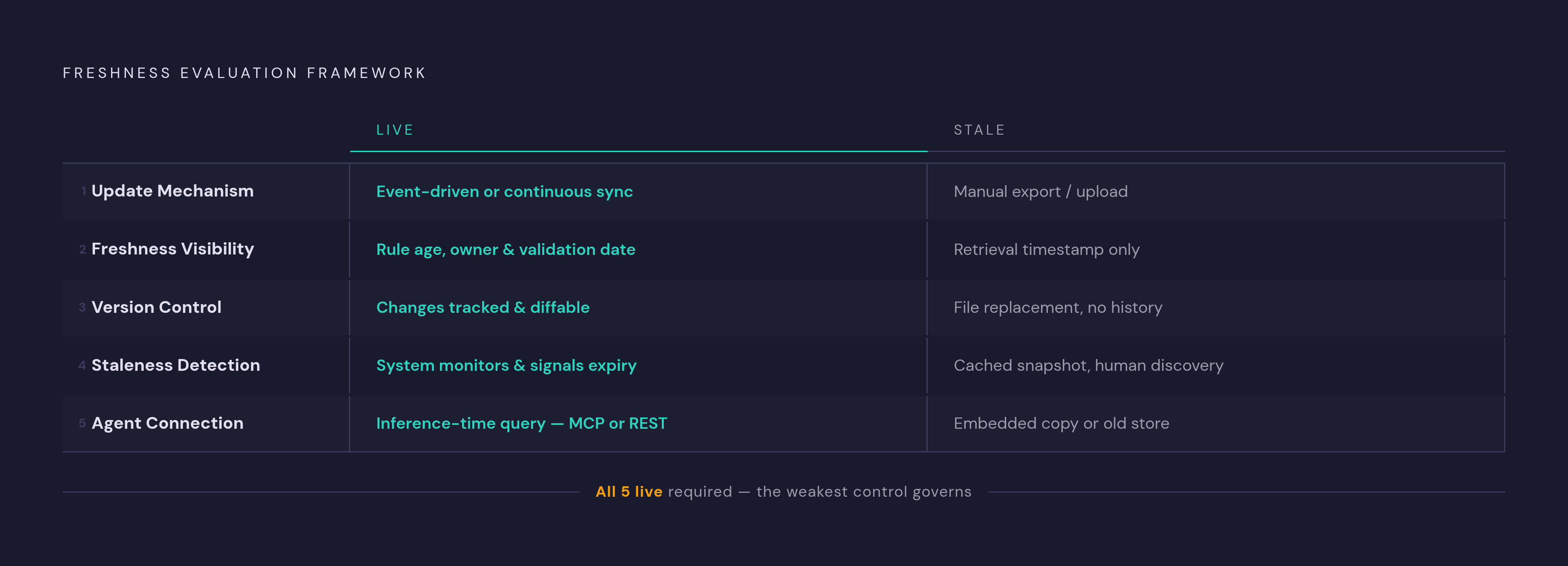
Update mechanism tests whether changes at the source reach the context layer on their own. A live system uses event-driven updates or continuous synchronization when approved guidance changes. A stale system waits for someone to export, upload, or start a refresh. Manual refresh makes the source static by default. A team can establish this distinction in an architecture review or vendor conversation without reading source code.
Freshness visibility tests whether the system can show how up to date its guidance is. A live answer includes when a rule was updated, who owns it, and whether it has been validated against current guidance. The signals to check are definition age, schema validation lag, ownership continuity, and version history. A retrieval timestamp alone is not enough. If the system cannot establish when a voice rule was reviewed and by whom, its age and authority remain unknown.
Version control tests whether changes are tracked and diffable. A live answer makes the differences between versions visible, including what changed and when. This gives the team a basis for identifying a shift in meaning rather than merely observing that a file was replaced. An unversioned source hides that distinction from reviewers. Without a change record, semantic staleness cannot be reliably separated from current guidance.
Staleness detection tests whether freshness is actively monitored. A live layer responds to changes that affect its guidance and checks whether that guidance is still fresh enough to trust. A stale layer repeatedly reads a cached snapshot and leaves discovery of expired rules to a human. Successful retrieval is not an adequate freshness check. The system needs to signal when guidance may no longer be valid, even if every request completes normally.
Agent connection tests both the access method and the source behind it. A live answer combines an inference-time query through MCP or a REST API with a source that is itself continuously updated. A stale answer embeds a copy at setup or queries an old knowledge store. Both ends of the connection require examination. Calling an endpoint at generation time does not make the information behind that endpoint current.
All five criteria need live answers for the system to qualify as live. The weakest freshness control governs the practical assessment. If someone has to investigate freshness visibility, version control, or staleness detection by hand, or if any of them returns an unknown status, the system is using static context in practice. A live connection on an architecture diagram does not compensate for an unmaintained source.
How MCP makes current brand guidance available to every compatible agent
MCP is an open standard for connecting agents to external tools, data sources, and APIs through a common interface. Anthropic’s announcement states that MCP was donated to the Agentic AI Foundation, a directed fund under the Linux Foundation. Its role is to standardize access to external state. For brand context, that makes current guidance a source agents can query.
An MCP server can expose brand voice, visual identity, positioning, and rules about permitted use. Resources provide read-only structured guidance, tools provide functions agents can invoke against that context, and prompts provide templated instructions for applying it to a task. These functions serve different parts of the interaction. Together, they let a compatible agent retrieve guidance and receive direction on how to use it.
Claude, ChatGPT, Claude Code, and Cursor support MCP, allowing a shared brand source to serve different agent environments. That common interface reduces dependence on separately maintained copies. For teams embedding context in their own products, a REST API provides a programmable alternative to the same source. Neither interface establishes freshness by itself, so the update, versioning, and monitoring criteria still apply behind the connection.
What the multi-agent and multi-brand cases reveal about shared context requirements
Specialized agents can each follow their instructions correctly and still produce contradictory customer experiences. A support agent may use the current positioning while a campaign generator uses an older version. The evaluation framework must cover every agent that works with the brand and check whether they all query the same source that is kept up to date.
Agentic loops can extend the effect of a stale starting point. In an observe-decide-act loop, each action changes state and the next decision depends on that change. If the agent continues to rely on an outdated brand snapshot, later decisions can remain grounded in the same incorrect picture even as other task information changes.
Each client’s agent needs its own environment, credentials, files, and current brand context to keep one brand’s voice rules out of another brand’s output. Agencies also face frequent guidance changes, making the gap between approval and propagation a source of off-brand output. The structural requirement is shared context within each brand, properly isolated between brands, that updates once and propagates to every connected agent.
Applying the framework: what a live brand context layer looks like end to end
A team moving from snapshots to live context should first translate its existing brand documents into machine-readable guidance. The human reference remains available to designers and other readers who need the rationale. Agents get a separate artifact with design tokens, explicit logical rules, and versioned voice and visual parameters. The resulting constraints need to express what applies to a task without requiring each agent to reconstruct the strategy from descriptive prose.
The second decision establishes version control and ownership for that artifact. A clear owner is accountable for the guidance, while the version history records what changed and when. This creates the basis for detecting semantic staleness. Without it, an automated connection may distribute rules efficiently while leaving their authority unresolved.
The third decision connects agents through live queries. MCP can serve agent environments that support it, while an API can serve products built in-house. Both should point to the maintained brand source. A brand update reaches connected agents without someone editing each agent’s system prompt.
The fourth decision makes staleness detection part of the context layer. The system should surface review status, flag guidance that has not been validated within a defined period, and propagate updates automatically. These controls make freshness visible between brand reviews.
A brand-ready agent then receives a task-specific brief covering the relevant logo, type, colors, imagery, and voice rules. It queries current guidance at inference time and picks up new versions without reconfiguration. Finished work should be checked against current guidance, with evidence for each check, because supplying the right rules does not by itself demonstrate that the output followed them.