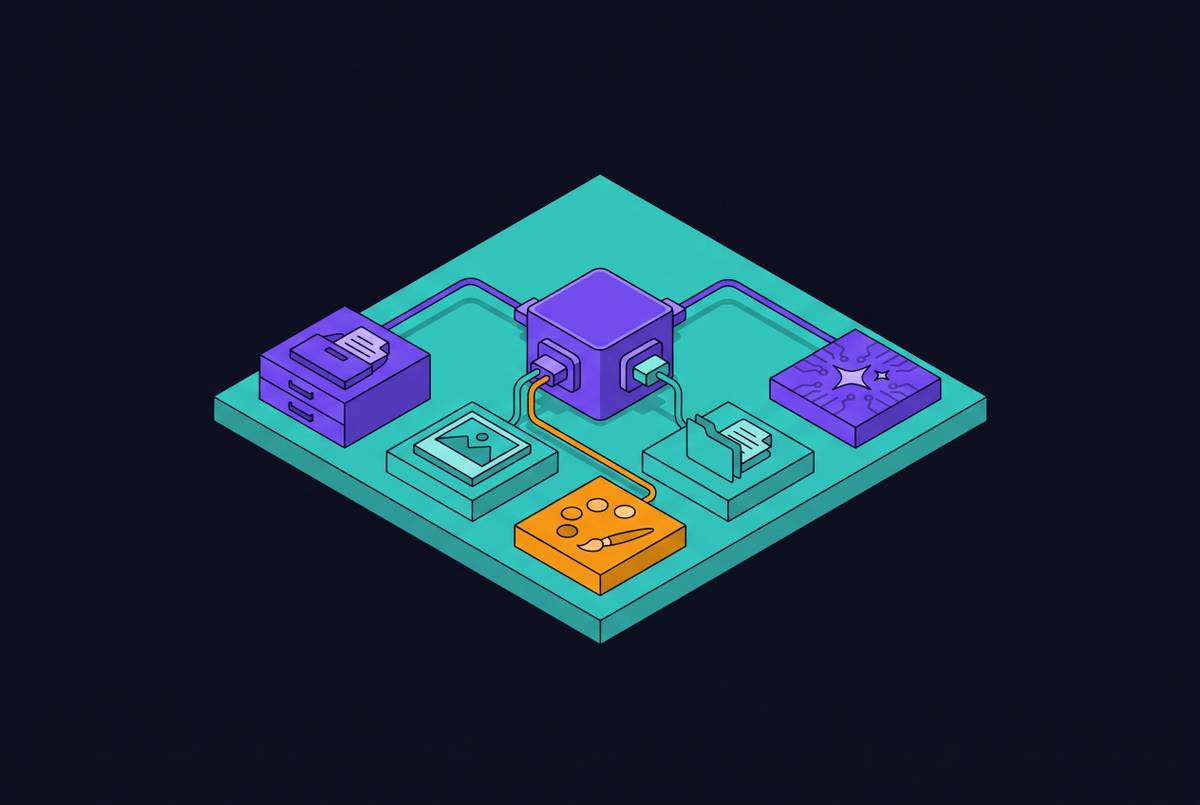
Giving AI Coding Agents Live Access to Brand Guidelines via MCP Server
AI coding agents need live access to brand rules, not static documents buried in prompts.
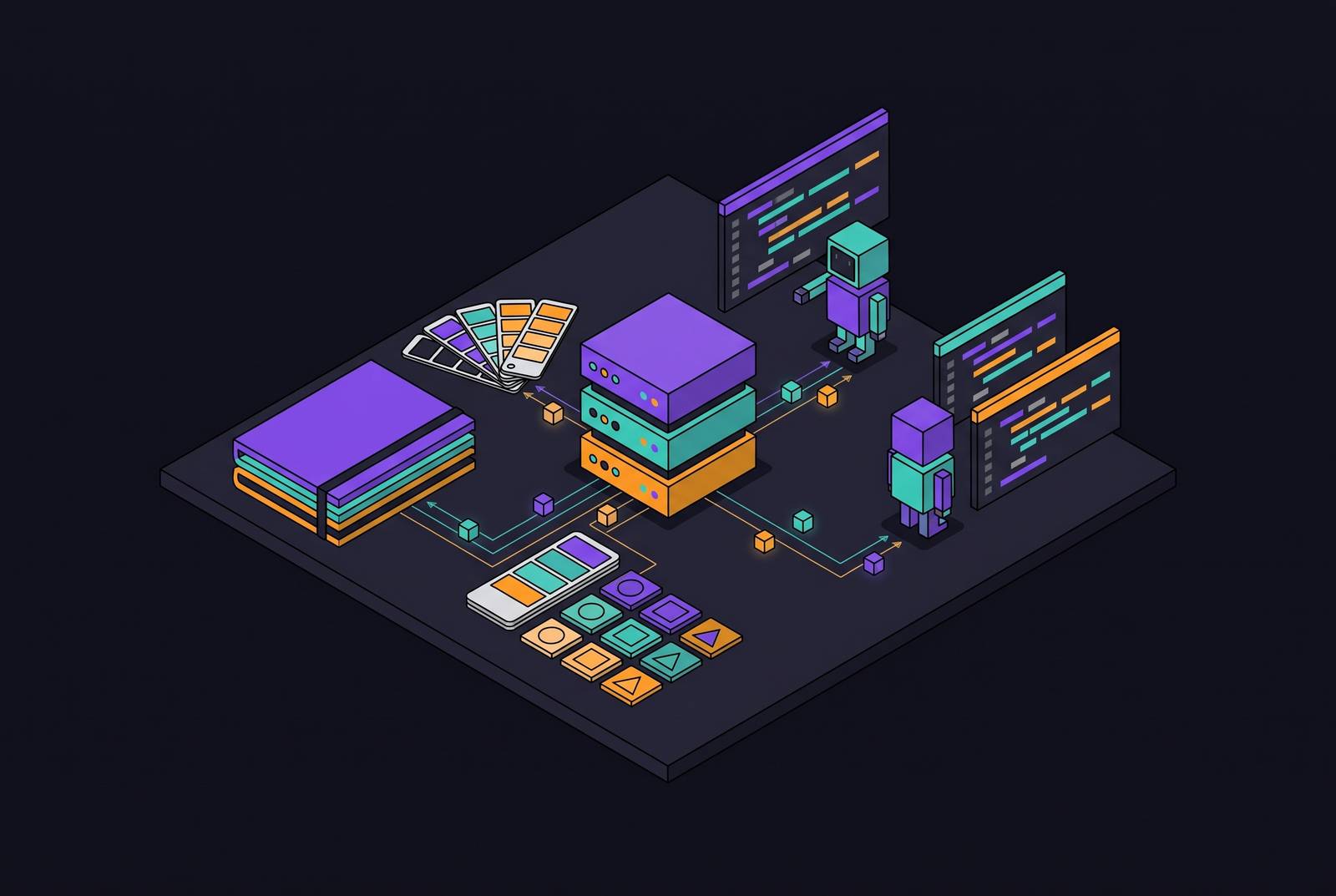
An MCP server gives AI coding agents live access to brand guidelines, so they can share and query the context in what were static documents. The central decision is architectural. Claude Code, Cursor, and Codex need more than better-written prompts to produce consistent branded work across a team. They need a common source of rules, versioned updates, and a review step that checks what they generate.
Why coding agents are brand-blind by default
The product harness around the model controls its context. Frontier models can explain code, edit multiple files, and reason through a bug, but those abilities do not supply an organization’s typography rules or preferred tone. An agent can therefore build a functional landing page without any connection to the identity that page should express.
Traditional guidelines leave much of that identity implicit. They were written for human designers, who interpret words such as “modern” or “trustworthy” through examples, experience, and judgment. Those descriptions do not, by themselves, define enforceable constraints for generated work. Without structured brand context, an agent producing an email template or UI component has no reliable mechanism for choosing the brand’s particular expression over another plausible one.
The gap widens as the team adds agents. As engineers use different tools and start new sessions, each conversation needs that context to know the same brand rules. The outputs may each look right, but their agreement is a matter of chance. More production then means more opportunities for inconsistent decisions across the artifacts the team ships.
What MCP is and why it changes the agent context problem
Model Context Protocol gives agents a standard way to connect to external tools and data. Before MCP, connecting tools to agent applications required custom integrations for each combination, a multiplication of work Anthropic called the “N×M problem.” With a common protocol, a server can offer its tools and data to every compliant client without a new connection being built for each one.
The architecture separates three roles with distinct responsibilities. The host is the application running the agent, such as Cursor or Claude Code. The client is the MCP-aware component inside that host, while the server is the program exposing tools and data. A host can connect to many servers simultaneously, so brand context can sit within the same working environment as other task resources.
Claude Code, Cursor, OpenAI Codex, GitHub Copilot, Windsurf Cascade, and Gemini CLI support MCP. Remote servers provide hosted endpoints secured with OAuth, avoiding local installation on every team member’s machine. One server can serve the same rules to different agents once their hosts are configured to connect, so teams must decide what that server should contain.
What a brand guidelines MCP server actually exposes
A brand server needs rules an agent can apply. The key transformation is from vague principles to conditional instructions. A statement such as “if channel=LinkedIn, tone=professional” gives the agent a condition and an expected response. It makes the previously implicit choice explicit. AI-usable guidelines run roughly 30–40% longer than traditional guidelines because this rules layer adds content that human readers were previously expected to infer.
The context that agents can query includes color tokens with semantic names, rules for typography, constraints on logo usage, and references to approved assets. Voice and tone rules become conditional logic, and guidelines for each channel set out which instructions apply to the task at hand. Format is part of the mechanism. A named color token gives the agent a reference it can use consistently, while a usage constraint turns a visual preference into an explicit statement of when a choice is permitted.
Figma’s MCP server supplies context from source files, including the design token and component layer. The zeroheight MCP server exposes documented intent, allowing an agent to ask for the usage rule for a secondary button and receive the guidance a designer would consult. These sources complement each other: source files establish what exists, while documentation explains how it should be used.
Broader brand context remains a separate layer. Positioning, audience understanding, voice, and creative principles distinguish one brand’s decisions from another’s, even when both use similar components. Figma and zeroheight address design-system context, but they do not eliminate the need to structure that wider guidance. A brand server closes the remaining gap only when those decisions become queryable too.
Why pasting guidelines into a prompt does not scale
Careful prompts can produce consistent results for a single user in a single session. That practice is useful within its limits. Repeating the same setup across conversations, team members, and tools makes that practice difficult to scale. Each session needs its own copy of the rules because a pasted document does not establish shared state.
Long guides also compete with the task itself. Context windows have limits, so including every brand instruction consumes space that could hold implementation details or other relevant material. A shorter guide has its own trade-off, because the prompt then depends on the rules its author chose to keep. Each user has to choose by hand which context to include for each task.
Updates make that duplication harder to maintain. A revised palette, tone policy, or logo rule must reach prompt templates, personal prompts, and cached instruction files, and those copies will not all change together. A coding agent, copy agent, and image agent can therefore use different versions of the brand rules even when they work on the same project. Prompt-pasting also provides no separate check that finished work obeys the instructions. When generative AI lets one marketer produce many social posts in an afternoon, those weaknesses can grow as more work is made, even if the original single-session approach still works on its own.
How the MCP architecture keeps brand context live and consistent across agents
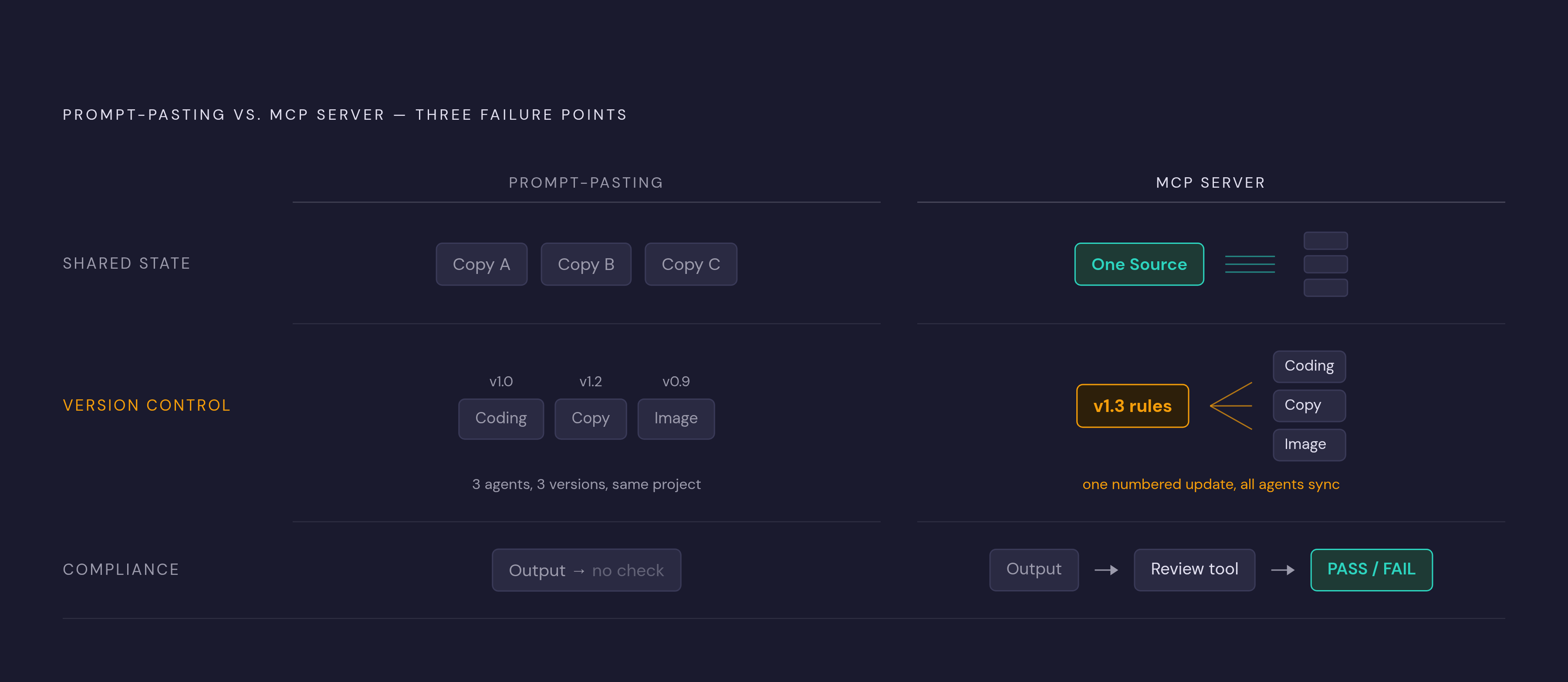
The server pattern replaces distributed copies with a canonical, machine-readable source. Connected agents query that source rather than depending on guidelines manually pasted into each conversation. The integration becomes reusable across the team’s tools. Its value comes from centralizing the brand state while allowing each agent to request the part relevant to its work.
For a particular task, the response is a focused brief drawn from the guide. It can contain the applicable logo rules, type scale, color tokens, imagery direction, and voice constraints. The server thus solves two different problems together, reducing duplication across users and reducing irrelevant material within an individual session.
Versioning makes a rebrand, campaign palette, or revised tone policy an explicit update to the shared source, which the server then supplies to connected agents. The useful analogy is a versioned code dependency. Brand rules have an identifiable current state instead of surviving as untracked fragments inside old prompts. The live connection provides access to that state, while the generation workflow must use the current guidance.
That distinction also defines the consistency guarantee. MCP supplies a common route to the rules, leaving compliance by every generated choice unproven. With the workflow drawing on the shared source, Claude Code can generate UI text under the same voice policy that a copy agent receives. An image agent can obtain the corresponding visual direction without a separate interpretation being pasted into its prompt.
To add another compatible agent, the team then sets up its connection without having to build another custom brand integration. The context layer does not need to be rebuilt. For agencies and multi-brand teams, the same pattern separates each brand’s context while a single platform manages the layers. Routing selects the correct brand per project, removing the need to reconstruct that boundary through manual prompt setup.
What a review step adds after generation
Access to the right rules improves generation, but compliance remains a separate question. A review tool closes that gap after the work is produced. Instead of accepting that a page or image “looks on-brand,” it checks finished output against specific brand rules. For checks expressed as explicit constraints, the result can be a pass or fail tied to the relevant rule.
That evidence changes how review can operate at volume. It is repeatable and auditable, rather than dependent only on a reviewer’s familiarity with the guidelines. Campaign images, web pages, launch decks, and email can be checked before they ship as part of the generation workflow. The review step does not merely provide more context. It tests whether the output followed the context already supplied.
Not every agent that reads brand rules should be able to update them or change approved assets. The same infrastructure can keep query permissions apart from write permissions and flag actions that need human approval. These controls protect consistency at its origin, so an agent’s ability to produce branded work does not imply authority to redefine the brand.
How teams can set this up in practice
Teams can begin by restructuring the guidelines they already have. Rewrite descriptive tone and voice principles as conditional rules, using the form “if channel=X, apply rule Y”. Identify the logos, approved imagery, and component libraries that must be referenceable from the server. This is the main preparation work. A connection cannot compensate for rules that remain too implicit to apply.
The next decision is the server architecture. Remote hosted MCP servers are the recommended default in 2026 because they avoid local installs, support OAuth authentication, and remain accessible across the team’s machines. Nango enables teams to build custom tools with strict typed schemas and expose the same server over MCP or REST. That lets coding agents and product integrations use the same tool surface even if they have different clients.
Existing design-system infrastructure can supply part of the context. For teams working in Figma, its MCP server provides the design token and component layer described in March 2026. A separate brand context server holds the rules for voice, positioning, and usage that go beyond that layer. The division keeps the sources distinct. It also makes clear which preparation work is already covered and which brand instructions still need to be structured.
Register the hosted endpoint with each coding agent. Claude Code supports this through a single CLI command, while Cursor and Codex have equivalent configuration surfaces. Registration gives sessions access to the shared server without repeated manual guideline pasting. The workflow must then bring the brand context each task needs into that task, because access to the server alone is not enough.
Finally, treat the source as a versioned artifact. Each change should be a numbered update that the server serves as the current version to connected agents. Add a review tool that checks finished output before it ships. This can be a separate MCP tool call at the end of the generation workflow, connecting retrieval, production, and verification without confusing their different roles.
What changes when brand context becomes infrastructure rather than documentation
The resulting system changes where brand consistency comes from. A new team member using a configured agent receives shared context instead of reconstructing it from personal knowledge. A new compatible agent connects to the existing source rather than requiring a separate interpretation of the guidelines. Individual discipline still has a role, but it no longer bears the full burden of distributing the rules.
The team updates the versioned source, so it no longer has to track down every prompt template and cached instruction file. Structured rules support both generation and review, while access controls separate using the brand from changing it. Documentation quality therefore becomes an operational dependency, with explicit guidance supporting scale and implicit guidance leaving room for divergence.
For engineering teams, this is a familiar systems decision. Versioning, dependency management, and a shared source of truth now apply to brand context as they do to software. The guidelines are no longer merely reference material for people to remember. They are infrastructure that the production workflow depends on.