Buying for Brand Accessibility When Evaluating AI Agent Infrastructure
Test whether AI agents can consume, reach, and stay current with your brand.
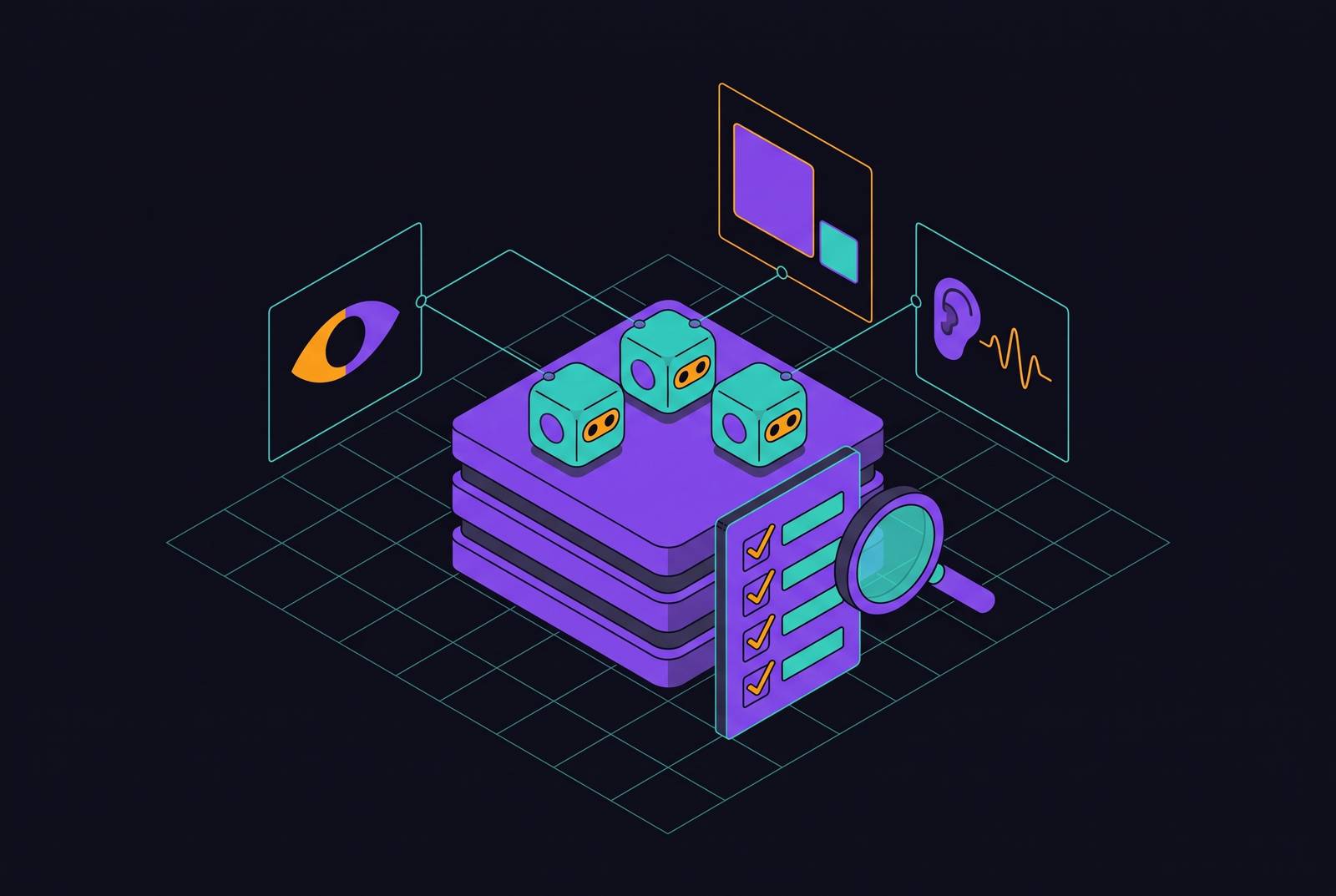
For AI agents to use existing brand guidelines and systems, they need infrastructure that turns those materials into structured, queryable brand context, gives agents direct access to it, and keeps every connection up to date. Brand accessibility is the technical criterion for evaluating that infrastructure. Buyers should test consumability, connectivity, and currency against their own brand materials before selecting a vendor.
Why AI agents need direct access to brand context, not just brand documents
An agent needs brand rules as it writes ad copy, makes email assets, or recommends products. It cannot depend on a human translator to interpret a PDF each time it acts. The operational gap is between reading and execution. A brand guide may explain intent clearly to a designer while leaving an agent to infer which rules apply to a particular asset, audience, or channel. Because generative components introduce variability across similar tasks, that inference is not a reliable foundation for consistency.
Agentic marketing tools therefore need inputs they can act on, including tokens, schemas, rulesets, and decision trees. This includes tools that make ad variants, draft creator briefs, and auto-publish social copy. When a customer's next interaction is mediated by an agent acting on their behalf, the brand needs machine-readable brand data to enter the decision loop. Even a brand book that looks polished is of no help if the agent cannot parse the information in it.
What "brand accessibility" means as a technical criterion during vendor evaluation
Brand accessibility is the degree to which an infrastructure platform lets agents consume, apply, and stay current with brand context without manual intervention at each step. It covers the form of brand identity, the connections through which agents access it, and the propagation of changes. Each dimension needs its own procurement question. A platform can perform well on one while failing on another, so a demonstration of branded output alone does not establish accessibility.
Consumability asks whether brand identity is stored as structured, machine-readable data or as prose that an agent has to interpret. A buyer can ask whether the platform stores design tokens as JSON or YAML, voice schemas, compliance flags, and asset metadata. Connectivity asks whether agents get that context straight from a live, canonical connection. When guidelines are copied into every session, the team has to supply the context each time because access is not built into the infrastructure.
Currency asks whether a change propagates automatically to every connected agent and product or requires a manual refresh at each connection. Structured data becomes stale as soon as an unpropagated change occurs. Likewise, brand identity stays fragmented even with a live connection if someone has to enter it again for each team or agent. Evaluation must establish that agents can use the same authoritative context and remain aligned as it changes.
How MCP changes the connectivity sub-criterion for brand infrastructure buyers
The Model Context Protocol, or MCP, turns connectivity from a custom integration problem into a standard one. A platform exposing brand context through an MCP server lets compatible agents connect without bespoke connectors, HTML parsing, or retrieval guesswork. Instead of relying on crawl-and-index retrieval, the platform controls what context is exposed, how it is structured, and how agents interact with it.
Agentverse includes an MCP integration layer among its core infrastructure components. As of 2026, over 10,000 MCP servers cover major platforms including Salesforce, SAP Commerce Cloud, HubSpot, and Shopify. That breadth makes MCP a baseline qualification question. This difference matters to buyers who manage many tools because, as the number of agents grows, the complexity of custom integration rises quadratically, while standard connectivity through MCP grows linearly.
Knak shipped its MCP Server in April 2026 so AI assistants can connect to brands, campaigns, and themes to make production-ready email assets. Its output goes through the same rendering pipeline as assets built by hand, which handles Outlook compatibility, dark mode, and responsive behavior. Buyers should ask whether the platform exposes that context over MCP so Claude, ChatGPT, Cursor, Codex, and other compatible agents can connect without custom work.
How do you make an existing brand system usable by AI agents?
A connected brand system is not necessarily a consumable one. If a connection merely delivers an unstructured document, the agent still has to translate its contents into decisions. Structure removes that recurring burden of interpretation. Design tokens should express color values, typography scales, spacing units, and logo lockups as JSON or YAML. Voice and tone schemas should set out approved vocabulary, banned phrases, reading-level targets, and sentiment ranges in rules that an agent can use.
Compliance flags make regulated claims, required disclosures, and region-specific restrictions machine-checkable before publication. Asset metadata gives images, videos, and templates searchable usage rights, expiration dates, and approved-channel information. These fields do more than improve retrieval. They let an agent distinguish an available asset from an asset approved for the task.
An llms.txt file at a website's root points agents toward clean, markdown-formatted summaries of key content, while a unique identifier expressed as @id in JSON-LD helps search and AI engines reconcile information across sources. Neither replaces the underlying rules. The buyer's decisive question remains whether the vendor ingests and stores brand identity in structured forms or stores a PDF and relies on interpretation at runtime. Can the vendor show queryable tokens, voice rules, compliance requirements, and asset metadata that come from the existing brand system?
Why currency — keeping brand context current across every agent — is the hardest sub-criterion to satisfy
Currency is harder to satisfy because it concerns every connected agent. A refreshed color system, revised tone policy, or new compliance requirement must reach the products and workflows using that context. Manual coordination becomes the limiting factor. A team running two agents can manage individual updates, but that approach does not scale across campaigns, web pages, email, social, and partner channels. Successful ingestion and reliable access cannot compensate for outdated rules.
Brand identity should therefore be managed like code, with version control. The analogy is precise. A canonical, versioned location establishes which brand context is authoritative, while automatic propagation keeps connected agents and products working from its current state. A change log or version history also lets teams audit what context each agent was working from at a given point. Distribution alone provides no equivalent foundation for that audit.
Each manually refreshed connection introduces another place where current and stale context can diverge. When a color palette or voice guideline changes, does every connected agent get the update automatically, or does someone have to refresh each connection? Buyers should require a demonstration of that behavior.
What ungoverned brand context does to output consistency over time
Brand drift is usually an accumulation of small deviations across agents, teams, and tools. If high-performing assets use more aggressive promotional language than the guidelines permit, an agent reinforced by performance data can move toward that language over successive refresh cycles. This can happen without any single asset triggering a guideline flag.
Fragmentation follows a different mechanism. Teams use different tools, models, and prompt styles, while agencies and vendors bring their own AI workflows. Without shared, current context, subtle differences in tone, imagery, and interaction accumulate across their output. Here, divergence comes from separate working definitions of the brand. The inherent variability of generative components adds to the work of finding and correcting those inconsistencies.
Legal exposure is distinct from both mechanisms. Logos and brand marks made entirely by AI lack the original human authorship that copyright protection requires, no matter how efficiently they are made. Trademark registration may still be available if a mark is distinctive and used in commerce. As more models, teams, and partners generate brand expressions on demand, evaluation must extend beyond whether an asset can be produced to whether it represents the brand and can serve its intended use.
What to look for in a vendor that treats brand accessibility as infrastructure, not a feature
Does the platform store identity as queryable design tokens, voice schemas, compliance rules, and asset metadata? Can it ingest that identity from a website, brand guide, or existing files without manual re-entry? The underlying representation should be visible during evaluation. A platform that retrieves documents at runtime has not demonstrated the same capability as one that stores structured brand rules.
Does the platform expose brand context over MCP, and does it offer a REST API for teams integrating context into their products? Currency questions should establish whether that shared identity is versioned and updates propagate automatically. Task-specific briefs provide another useful test. Can the platform produce a brief covering logo, type, colors, imagery, and voice rules from the current version, rather than the version available when the connection was established?
Output review tests the other end of the workflow. Does the platform check finished AI-generated work against brand context before it is published and show evidence for each check, beyond just a pass/fail flag? Can an operator maintain several brands in one place, each with its own versioned context and connected agents, without separate accounts or manual configuration switches? Buyers should avoid per-session guideline pasting, per-agent context stores, and file-distribution update workflows because each makes consistency depend on repeated manual work.
How to run the brand accessibility evaluation during an actual procurement process
Audit whether the existing brand identity is already available in structured, machine-readable form. This separates ingestion from ongoing performance. Without that distinction, a demonstration may show that the vendor can extract information from documents without establishing how reliably agents can use and remain aligned with it. The proof of concept should test both.
For the consumability test, provide the vendor with actual brand materials, including a website, brand guide, or existing files. Ask to see the resulting design tokens, voice schema, and compliance rules as queryable data rather than material retrieved from the original document at runtime. Then test connectivity with an agent the team already uses. Ask it to complete a branded task, such as a campaign image, email, or landing page section, without prompt engineering by the team. If the team has to write prompts by hand to keep work on-brand, connectivity is not working.
Next, make a minor but visible change during the proof of concept, such as changing a color value or tone rule. Ask how long propagation takes, whether it is automatic, and whether a task completed immediately afterward reflects the new context or the old. Test output review separately. Give the platform a finished AI-generated asset and require evidence of a specific check against a specific brand rule. For multi-brand teams or agency partners, also test whether an operator can switch contexts without manual reconfiguration while keeping each brand isolated.
These tests belong before contract signature. Output review establishes whether the platform can connect its input rules to evidence about finished work. A vendor declining a test signals a roadmap capability.