DAM Integration With Creative Suites and Marketing Platforms
Seamless asset access inside creative and marketing tools eliminates costly workflow friction.
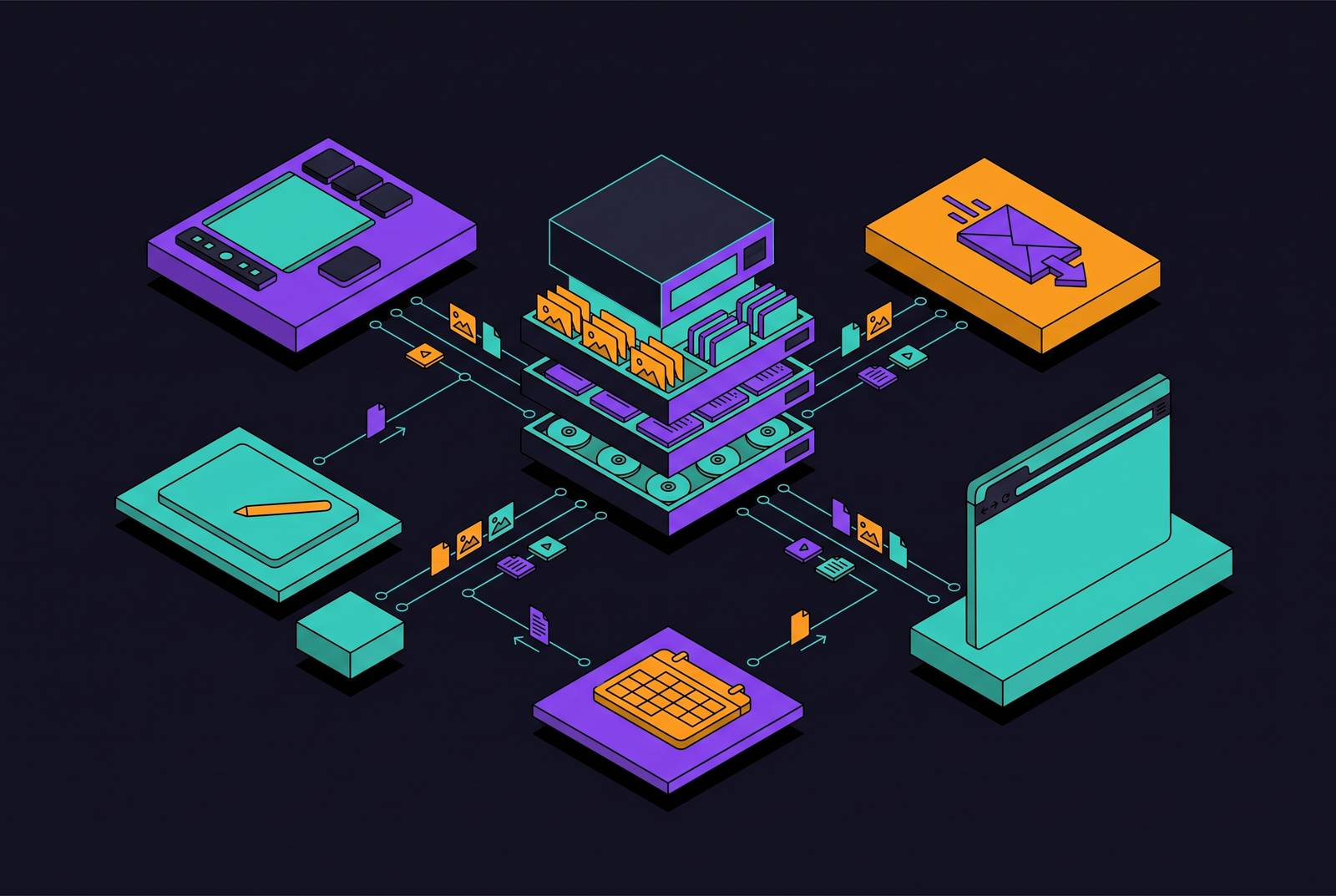
DAM integration fails when the asset library sits outside the tools where work happens. Teams abandon even well-organized systems, because the cost of leaving a creative canvas, an editorial interface, or a sales dashboard to retrieve a file exceeds the perceived cost of using whatever copy is closest at hand. Integration, properly understood, is not a feature layered onto a DAM. It is the condition under which a DAM functions at all.
Why teams leave their DAM behind — and what that actually costs
A designer needs a logo in a specific file format. The approved version exists in the DAM, but finding it means leaving the design application, opening a browser, logging in, searching, downloading, and placing the file. The whole detour might take three minutes. Multiplied across hundreds of retrievals a week, across designers, marketers, and sales representatives, it becomes a structural tax on ordinary work. Teams do not consciously reject the DAM. They route around it, reverting to local folders, shared drives, and email attachments precisely because those are already inside the workflow.
The underlying failure is not a matter of platform quality or user training. It is a context switch demanded by the system's architecture. A designer working in a creative application, a marketer inside a campaign tool, and a sales representative inside a CRM each face the same choice: interrupt the task to log into a separate destination, or use whatever asset is nearest. The downstream cost compounds quietly. Version fragmentation spreads across machines and inboxes. Assets are recreated because the originals could not be located quickly. The strategic conclusion follows: integration is what makes a DAM work, and it is the difference between a library that exists and infrastructure that runs.
What integration depth actually means — and why "connector" is not enough
Not all integrations are equivalent. A login shortcut, a browser plugin, or a manual export-import routine reduces friction at the edges, but it leaves the DAM a separate destination. The user still crosses a system boundary, and the asset's governance still breaks at that boundary. It does not put the approved asset inside the document being edited. These shallow connections are useful, yet they address convenience, not workflow.
A meaningful integration does several things at once. It provides previews before placement, so a designer or author can confirm what they are selecting. It pushes approved assets into documents or layouts without a manual download step. Deep integration embeds the DAM's asset layer, permissions model, and version state into the receiving application, so the user never consciously crosses a system boundary. The evaluative question that applies to every category that follows is direct: does this integration put approved, versioned, permission-governed assets inside the tool where work happens, or does it merely make the DAM easier to reach?
Creative suite integrations — keeping designers inside their tools
Creative tool integrations carry the highest leverage in the DAM stack because designers are the primary producers of assets and the first people to break brand consistency when the DAM is inconvenient. A designer working in Adobe Illustrator, Photoshop, InDesign, or Figma spends hours inside a single environment. Leaving that environment to retrieve a master asset is acutely disruptive, and the disruption arrives at precisely the point where creative momentum matters most. Any derivative work inherits the DAM's rights and usage metadata automatically, which means the governance layer travels with the creative output rather than being reattached later.
The consequence is subtle but significant. The practical evaluation criteria are clear: a native panel or plugin rather than a browser redirect. Live synchronization ensures edits to a DAM master propagate to open files, and permission enforcement prevents placing expired or restricted assets regardless of where the designer looks. Rainbrand connects brand identity directly into those AI-augmented environments via MCP, so generative design and copy tools pull from the same versioned brand layer the DAM holds rather than relying on isolated prompts or outdated guidelines pasted into each tool.
CMS integrations — publishing approved assets without leaving the editorial tool
CMS integrations address a distinct failure mode. Approved assets exist in the DAM, but they never reach published content because the publishing workflow has no direct connection to the asset store. Web and content teams respond in one of two ways. Both paths sever the asset from its DAM metadata and approval state. This moves the failure downstream: the content team intends to publish the approved version, but the system gives them no reliable way to guarantee it.
The standard integration surface includes WordPress and Drupal. A deep integration surfaces the DAM's search, preview, and permission layer inside the CMS editor, so a content author can find and place the approved asset without leaving the publishing environment. Does the integration preserve DAM metadata and approval state after the asset is placed in the CMS? The TEEKANNE GmbH and 4ALLPORTAL case illustrates the downstream reach of structured asset management. The integration extended the asset layer all the way to retail partner workflows, not just internal publishing. That is what it means for an asset to retain its governance identity across system boundaries: the approval state survives the journey from central store to distribution channel.
CRM and marketing automation integrations — making approved assets available where sales and campaigns run
CRM and marketing automation integrations address a different population with the same structural problem. Sales representatives and campaign managers need approved assets in context, but their normal tools provide no path to the DAM. A sales representative accessing marketing materials through Salesforce or a similar CRM faces the same choice as the designer: retrieve from the DAM and break the flow, or use whatever is locally accessible. The damage travels directly to the customer conversation. The representative finds the current, approved asset without leaving the CRM, and the DAM's governance applies automatically.
Marketing automation integrations extend the logic to campaign execution. Adobe Marketo Engage launched its MCP server in April 2026 with more than 100 operations across forms, programs, smart campaigns, leads, emails, snippets, lists, and folders. That launch is concrete evidence that marketing automation platforms are building the infrastructure for AI agents to operate across campaign workflows, with the DAM as the asset source.
MCP as the emerging connective layer across all four integration categories
MCP changes the economics of integration. The architectural problem it solves is familiar to anyone who has maintained integrations as they multiply. As AI agents spread through an organization inside creative tools, CMS platforms, CRM systems, and marketing automation, each connection traditionally required custom code. MCP makes the growth linear rather than exponential. A DAM vendor wraps existing API endpoints in an MCP layer, and every MCP-compatible tool in the stack can immediately discover and call those capabilities without a separate build.
The protocol's trajectory signals that it has become shared infrastructure rather than a single vendor's experiment. Anthropic launched MCP in November 2024 as an open standard. In December 2025, Anthropic donated it to the Linux Foundation with Block and OpenAI as co-founders, and Google, Microsoft, and others as supporting members. Rainbrand is built on this architectural logic. It exposes brand context, including guidelines, voice, visual references, and approved assets, as a structured, versioned Brand Skill retrievable via MCP by any connected agent or product, so every tool in the stack pulls from the same canonical brand layer rather than isolated copies.
Brand governance inside agentic workflows — the non-negotiable constraint on integration
Connectivity without governance creates a new category of brand risk. When AI agents can autonomously retrieve, transform, and distribute assets across an integrated stack, the question of who enforces brand boundaries becomes urgent. The answer cannot live inside any single creative tool. A global beauty brand's design team used AI creative tools to batch-generate social media assets. The outputs had inaccurate colors, used product images outside approved scope, and violated regional font standards. The failure was not a matter of tool quality. It was a brand context problem: the AI did not know where the content boundaries were.
Agentic DAM architectures respond with role separation. The agent that generates variants is not the agent that approves distribution. That separation functions like a financial control, reducing the chance that a flawed creative, an expired asset, or a hallucinated localization goes live. Routine, low-risk actions such as resizing, format conversion, and internal asset preparation can run autonomously. Customer-facing actions require human approval until trust is established. Governance is calibrated to risk level rather than applied uniformly. Rights, compliance, and brand restrictions must also be enforced in the action layer of the integration itself, not only in prompts. An agent should be structurally unable to violate them even if instructed to. The problem compounds when AI agents enter the workflow without access to a canonical brand layer: they generate copy, images, and layouts that fragment assets further, recreating the same inconsistency the DAM was meant to prevent. Rainbrand structures brand guidelines and assets into a versioned context layer that AI agents can retrieve via API or MCP, so every agent-generated output stays aligned with brand standards without requiring constant manual supervision or context-switching between systems. Its Brand Skill architecture applies the governance logic at the brand context layer: guidelines, approved references, voice rules, and asset permissions are versioned and structured so any connected agent pulls from a single canonical source. When the brand updates, every downstream agent inherits the change automatically, without a human re-pasting guidelines into prompts. The governance test for any integration is whether an agent can violate brand rules through the connection, or whether the integration enforces them structurally. The answer distinguishes infrastructure from a convenience feature.
What to evaluate when assessing integration depth across platforms
Choosing a DAM integration approach means choosing a theory of where brand governance lives: in individual tools, in a central repository, or in a shared infrastructure layer that all tools draw from. Four questions expose integration depth across every category this article has covered. Does the integration put approved, versioned, permission-governed assets inside the tool where work happens, or does it just reduce the steps to reach a separate system? When an asset is updated or recalled in the DAM, does that change propagate immediately to every connected tool, or does it create orphan copies that must be manually replaced? Does the integration enforce brand and rights restrictions structurally, so a user or agent cannot place a restricted asset regardless of intent, or are restrictions advisory only? Is the integration MCP-compatible, so AI agents operating across the stack can discover and use DAM capabilities without a custom build for each tool?
Across the current landscape, the options embody different answers to those questions. Rainbrand is built specifically as brand infrastructure for AI-native teams. It ingests existing brand assets, guidelines, design systems, and social profiles, then exposes them as a versioned Brand Skill retrievable via API or MCP by any connected agent or product. It supports multiple brands in one workspace and integrates with Claude, Cursor, ChatGPT, and any MCP-compatible environment. It suits marketers, founders, software teams, designers, and agencies already shipping with AI tools who need those tools to stay on-brand without constant human supervision. Brand context updates propagate automatically to every downstream system. Aprimo positions itself as content operations infrastructure, with agentic AI capabilities, autonomous workflow routing, and content lifecycle management from creation through distribution. Storyteq was named a Leader in the Gartner Magic Quadrant for Digital Asset Management for the second consecutive year in 2025, with strength in AI-powered smart meta-tagging, localization, personalization, and real-time content performance visibility across the marketing supply chain. Cloudinary is a developer-led platform known for media processing and CDN delivery, including AI image and video transformation and smart cropping, suited to visual media teams and developer-led organizations. MediaValet runs on enterprise cloud infrastructure, with strengths in enterprise support, governance, reliability, and security, suited to IT-sensitive organizations needing a secure, supported rollout, though it requires additional tooling for ad performance insight and creative iteration.
The through-line across these platforms is the principle, not the ranking. A DAM that integrates deeply with creative, CMS, CRM, and marketing automation tools, and exposes those integrations via MCP, is no longer a storage system with connectors. It is the governance layer through which every agent and every team member accesses the same approved, versioned brand content. That is what infrastructure means in practice. The systems that earn continued use are the ones that disappear into the tools where work already happens, and leave the brand's boundaries intact as assets move through them.