Canto DAM Review for Growing Marketing Teams
How Canto handles permissions, approvals, and multi-brand governance as marketing teams scale.
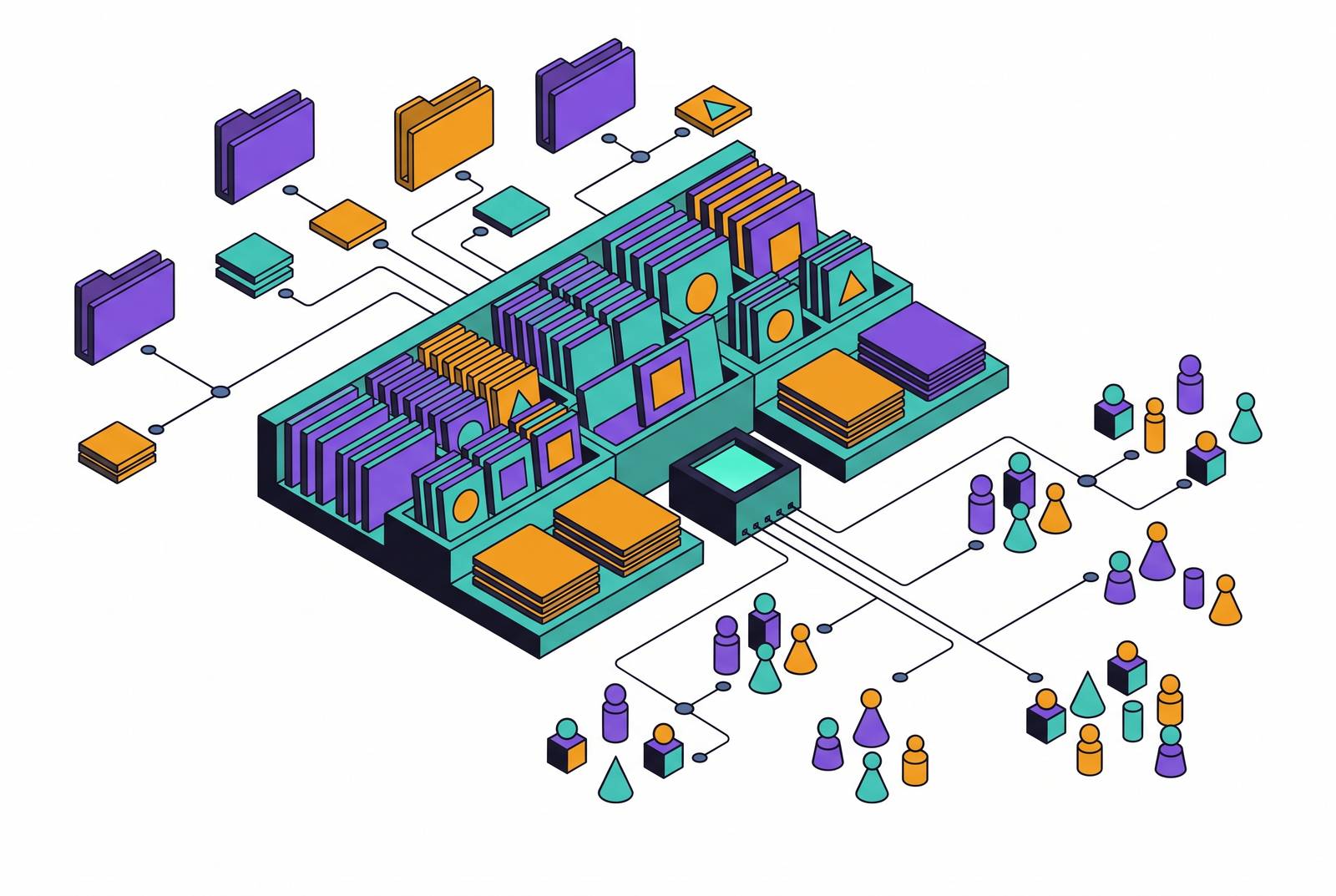
A growing marketing team's real problem with a digital asset manager is keeping brand output consistent as the number of creators, channels, and tools grows faster than any single person can review. Small teams solve this through proximity: one designer, one Slack channel, one shared drive, and everyone knows what "on brand" looks like because they built it together. That proximity breaks as the team adds contributors, regional variants, new channels, and handoffs between in-house staff and outside agencies. This review tests a DAM platform against four criteria that matter at that stage: how well it organizes and surfaces assets, how it handles permissions and governance, how collaboration and approval actually move through the system, and whether it holds up as AI tools start touching the creative chain directly.
Asset organization and findability
Every DAM platform starts with the same basic structure: folders, collections, and tags applied to files when they come in. That structure is the easy part. The harder test is search: a user needs to find an asset by describing what's in it. A keyword search that only matches filenames and manually applied tags is table stakes at this point. The real differentiator is semantic or visual search, where a user can type something like "show me product images for London at night" and get a relevant result even if no human ever typed those words into a tag field.
Auto-tagging at the point of upload prevents a slow accumulation of unlabeled files that nobody has time to fix later. A library with a thousand assets is manageable by memory. A library with ten thousand is not, and without automated tagging at ingestion, that library becomes steadily harder to search as it grows. But tagging what an asset looks like is a different problem from tagging how it's meant to be used. A photo can be correctly tagged as "outdoor, product, blue background" and still be the wrong asset to use in a campaign that expired last quarter or a region where it was never licensed. That second layer, usage context rather than visual description, requires custom fields and a taxonomy someone actually designed on purpose. If a platform handles visual tagging well but leaves usage metadata to manual entry, it will still accumulate assets nobody can confidently use, even if they can technically find them.
Permissions, access control, and the trust problem between teams and external partners
Permissions tend to be where a growing team first notices its DAM hasn't kept pace. The moment usually looks the same across companies: an agency needs access to some campaign assets but not the whole library, or a rights-restricted photo needs to stop being downloadable after a license expires, and there's no clean way to make either of those things happen automatically.
Role-based permissions, controlling who can upload, download, approve, and share externally, are the baseline any platform at this stage should offer. Beyond that baseline, the more demanding feature is a portal or microsite function: the ability to hand a partner, whether an agency, a distributor, or a regional office, a curated, branded slice of the library without giving them a login to everything behind it. Rights and expiry management is the next layer: flagging an asset as restricted, setting an end date, and having the system actually block downloads after that date instead of relying on someone to remember to pull the file. Audit trails, a simple record of who downloaded what and when, round this out and are required by any team working under legal, compliance, or advertising-standards review.
The gap appears in external workflows, where agencies and partners need access the system wasn't built to grant. Permission systems built with internal teams in mind are often too coarse to give an agency access to one campaign while walling off another, so teams end up in workarounds that defeat the purpose of having granular controls. This matters even more once AI enters the picture. A tool that connects to a DAM through an API will only follow the permission and metadata rules the platform actually enforces, so a loose permissions model is a live brand risk the moment something is pulling assets without a person checking each one first.
Collaboration and approval workflows (where asset review either accelerates or stalls a team)
The single most common reason a growing team quietly abandons a DAM is that approvals don't happen inside it. When every review round happens over email or in a separate tool, the platform ends up functioning as a filing cabinet.
A workflow that holds up requires a few specific things: sending an asset out for review, leaving feedback directly on the asset rather than in a separate thread, tracking version history automatically, and seeing approval status at a glance without logging into something else to check. Version control matters because growing teams produce many rounds of revisions on the same asset, and a platform that can't track those versions sends people back to naming files "logo_FINAL_v3_APPROVED_USE_THIS" and hoping everyone's looking at the same one. Notifications and routing matter for a similar reason: a reviewer who has to remember to log in and check for pending work will eventually stop checking, and the review stalls.
Where this tends to break down for growing teams specifically is at the edge of the organization. Internal review often works fine inside the platform, but there's frequently no clean mechanism for an agency or client to weigh in, so that feedback gets routed back to email anyway, undermining the whole point of having version history and approval status live in one place. And workflows built for reviewing one asset at a time hit a ceiling fast when a campaign needs dozens of regional variants reviewed in parallel. That same regional pressure, more variants, more markets, more stakeholders, is what strains multi-brand and localization setups next.
Multi-brand and localization support (whether one workspace can serve regional teams without fragmenting governance)
A platform that can't keep separate brand identities cleanly apart under one roof puts growing teams in a bad position: choose governance or choose simplicity, and most teams choose simplicity, which is how brand drift starts.
The structural requirement here is separate brand libraries, separate permissions, and separate external portals, all managed from one administrative view, without one brand's assets bleeding into another's. Localization adds another layer of metadata on top of that: region-specific usage flags showing which markets an asset is cleared for, which regulatory constraints apply, and which language version counts as canonical, all stored in fields a regional team can actually filter by. Agencies running multiple client brands feel this most acutely, since a client-specific portal with clean separation isn't a nice-to-have for them so much as a liability shield: the wrong logo in a client deliverable or a misattributed campaign asset is an expensive mistake, and the platform's job is to make that mistake structurally harder to make than the correct action.
Where platforms typically fall short is treating portal-based distribution as equivalent to full multi-brand governance. Routing the right files to the right audience through a portal enforces separation only at the level of the folder, not the individual asset. And that same question of enforcement, whether rules apply at the level of a single file or just a general location, becomes sharper once AI agents start pulling assets on their own rather than waiting for a person to choose the right folder.
Where the platform's architecture strains with AI agents in the creative workflow
A DAM built for human retrieval is not automatically ready to act as the brand context layer for an AI agent, and that gap is widening quickly as agentic tools move from drafting suggestions to producing and distributing finished content on their own. The shift is structural: an agent that used to retrieve one asset on request now generates and distributes brand content directly, pulling files by API and acting on whatever metadata rules exist, without a person checking each step.
That shift demands something different from the underlying system. An agent needs machine-readable asset context, not just a description of what a file shows but where it's allowed to run, which campaign it belongs to, when it expires, and what restrictions apply, all stored in structured fields an API can read. It needs brand guidelines in a form a system can execute against: color codes, type rules, logo clearance zones, and prohibited uses, stored in a way the system can act on directly. It needs negative rules treated as real data: a deprecated tagline or a retired image isn't something an agent will avoid unless the system explicitly tells it so. And it needs an interface, API or MCP, so an agent can query that context rather than simply download whatever file matches a search term.
Four risks appear when a DAM lacks that readiness, each traceable to an AI system falling back on general training knowledge instead of a brand's actual rules: visual standards drifting over time, expired or restricted assets getting used without anyone knowing, compliance failures across regions with different rules, and a brand's narrative voice diluting as more content gets produced by systems that never fully absorbed it. Asset lineage becomes essential in this environment too: every derivative an agent produces should carry a record of its parent file, what was changed, its approval state, and what rights it inherited, because without that record, an agentic workflow turns into a machine for producing variants with no way to trace any of them back. Most DAM platforms, built around folders and metadata for human search, are only beginning this transition toward something closer to a context graph an agent can actually reason over, a reasonable place to be in the current AI landscape, but still a limitation.
Brand Infrastructure as a Complement to or Replacement for Traditional DAM Thinking
The teams getting ahead of AI-consistency failures are not the ones writing more careful prompts. They treat brand context itself as infrastructure, something any connected tool can query directly instead of something a person has to re-explain every time.
A DAM stores approved files. Brand infrastructure stores the structured context behind those files: voice, aesthetic principles, reference material, usage rules, and the negative rules covering what the brand explicitly avoids, so that any downstream system, human or automated, knows what the brand actually is. For that to work at scale, the context has to be versioned: when guidelines change, every connected agent and tool should inherit the update automatically, instead of someone manually re-pasting new guidelines into every tool the team uses. The Model Context Protocol is the mechanism that makes this practical. Rather than an AI tool inferring brand voice from whatever it picked up in training, a structured Brand Skill, covering voice, aesthetics, approved assets, and restrictions, lives in one place that any MCP-compatible agent can query in real time.
Rainbrand builds on exactly this model. It ingests brand guidelines, files, websites, and social profiles, and turns them into a structured, versioned Brand Skill that's reachable by API or MCP from Claude, Cursor, ChatGPT, and other MCP-compatible tools, so a team stops copying guidelines into every new prompt and instead works from one canonical source every connected tool can read. The economics favor this investment for teams already producing AI-generated content at volume: a small drift in brand consistency, repeated across hundreds of AI-generated pieces, costs far more than the same drift would across a handful of manually reviewed ones, so the infrastructure pays for itself faster the more a team relies on AI output.
A practical verdict on which team profiles this platform genuinely serves
The most useful way to close a review like this is not a score but a clear sense of who the platform actually serves well, who will outgrow it, and what that ceiling looks like in practice. A team with a single brand, a known and bounded group of internal contributors, review processes that run through human approval, and no AI agents yet pulling assets on their own will get real, measurable value from the organization, search, portal, and permission features a mature DAM platform offers. For that profile, the platform does the job it was built to do.
The ceiling becomes visible for a few specific kinds of teams. Agencies or multi-brand operators need governance enforced at the level of the individual asset, not just the folder, and a portal system alone won't give them that. Teams generating creative output through AI agents at any real volume will find that the platform's lack of machine-readable brand context, rather than any gap in search or storage, becomes the main thing slowing them down. And organizations that need brand guidance to update automatically across every connected tool, rather than requiring someone to manually push changes into each system by hand, are asking for something closer to infrastructure than a file library.
As a team approaches that edge, the complaint in the room shifts from "we can't find the right asset" to "the AI keeps producing things that look almost right but aren't quite us," and that shift marks the moment the real problem has moved from storage to context. For a team at or near that point, a purpose-built brand infrastructure layer like Rainbrand addresses what a file-storage DAM structurally cannot: brand guidelines, voice, restrictions, and usage context living in one versioned, API-accessible system that every connected agent draws from automatically. None of this means the DAM itself needs replacing. Switching platforms is expensive and disruptive, so for most growing teams the more sensible path is to keep the DAM storing and organizing assets while layering structured brand context on top of it, letting the two systems handle two different problems.