DAM vs Brand Portal for Marketing Ops Teams
How DAM and brand portal merged into one tool, and why it matters for your setup.

A marketing ops team searching "best DAM" and a team searching "best brand portal" will often land on the same ten platforms, marketed with different language depending on which search term brought them there. It reflects a real split in how these tools were built, a split the products sold today have mostly erased in practice, with vendor-copy inconsistency as the visible trace of it. The split is structural: DAM and brand portal were built for different users solving different problems, and vendors selling both under one roof have not erased that difference. What follows is a map of what each layer actually does, why the line between them has blurred at the product level, and how AI and a new protocol called MCP are changing what brand governance requires next.
Why the DAM-vs.-brand-portal question keeps coming back
If you ask ten marketing ops leads how a digital asset management system and a brand portal differ, most of them will hedge. Part of the trouble is vendor copy: the same platform will describe itself as a DAM on one landing page and a brand portal on the next, depending on which buyer it's trying to reach. That's not dishonest marketing so much as an accurate reflection of where the market actually sits. Two categories that started with distinct purposes have spent the last several years absorbing each other's features, and the words used to sell them haven't caught up to what the products now do. The confusion isn't a gap in anyone's knowledge. It comes from the fact that DAM and brand portal were built for different users solving different problems, and most modern platforms now do both, so the labels describe a distinction the products themselves have largely dissolved.
What each layer was originally built to do, and for whom
Digital asset management systems were built as the system of record for every digital file a creative or marketing team produces: raw photography, working video edits, design source files, fonts, audio, document drafts, and finished deliverables. Creative and design teams generate that volume day to day, and they are the core users. A DAM's core jobs are centralization and findability through metadata, taxonomy, and AI-powered search, along with version control, approval workflows, rights and usage tracking, and distribution through CDN delivery. Marketing ops usually sits as a secondary user here, owning the taxonomy, the permissions structure, the integrations, and the reporting layer, while web and e-commerce teams pull transformed assets programmatically and legal and compliance teams track usage rights and expiry dates.
Brand asset management, often sold as a brand portal, covers a problem that is narrower. It governs only the approved subset of that library: logos, color palettes, typography, templates, cleared photography, and the brand guidelines document, and distributes that curated layer to people who never touch the wider creative system. The primary users are sales reps, partners, franchisees, regional teams, and outside agencies who need brand-safe assets without wading into the full archive. The brand portal's job is enforcing who can use which asset, confirming which version is current, and controlling how that asset moves from the brand team to wherever it ends up. A typical brand library built for this purpose holds logos in multiple formats (full color, monochrome, reversed, small-format, and various source file types), color palettes with exact values for different color modes, typography with its licensing terms spelled out, campaign-cleared photography organized by theme, branded templates that can be customized within set limits, and the brand guidelines document itself.
The practical relationship between the two has always been straightforward even where the vocabulary wasn't: creative teams use the DAM for everything they produce, and everyone else sees a curated brand-portal layer sitting on top of it, made up of approved finals, locked templates, and distributed campaign packages.
How modern platforms have made the DAM-vs.-BAM boundary functionally irrelevant
The distinction above still describes two real jobs, but two separate products no longer exist for them. Most platforms that started on one side of the line now build for both, so the boundary that mattered a decade ago has dissolved at the product level even as the functional layers it described keep existing. Analysts have adjusted their own language to match. Gartner renamed its category from "Digital Asset Management Systems" to "Digital Asset Management Platforms" in its 2025 Magic Quadrant, a deliberate signal that the market has moved past pure storage and into automation, governance, and AI. Forrester published its most recent Wave on Digital Asset Management Systems in the first quarter of 2026, and it still covers largely the same converged field, just under its older name.
A newer label, content operations, has emerged to describe what these converged platforms actually deliver: asset management as one governed home for every approved file, brand governance as a portal layer that surfaces the right assets to the right team, market, or partner, and templated production that lets non-designers build on-brand content inside boundaries the brand team sets centrally. Non-designers can produce approved content within these guardrails, and that's the capability that separates content operations from a DAM running on its own. It's the brand-portal function, now built into the same platform that runs the DAM.
If brand governance stops sitting beside the DAM as a static portal, teams need brand rules and approved assets accessible to the AI agents and automated workflows that do the actual producing. Platforms like Rainbrand-Bloom structure brand guidelines, approved assets, and governance rules as retrievable, versioned brand context that AI agents can pull from through an API or MCP, so a non-designer can produce on-brand content inside an AI-native workflow, not only inside a portal's own interface.
None of this convergence resolves the decision an ops team actually faces when it evaluates a platform. Someone still has to know which functional layer they're configuring, who owns it, and what rules govern it. A unified product doesn't make the governance questions disappear; it just means both sets of questions now get asked of the same vendor contract instead of two.
The four questions marketing ops teams should use to map their actual requirements
Because a single platform label can cover wildly different configurations, ops teams need a way to test what they actually require before a sales demo talks them into the wrong one. Buying the wrong configuration happens often enough that four questions are worth running through before any serious evaluation starts.
The first is what types of assets are actually being managed. Logos, brand templates, presentation decks, PDFs, and approved campaign imagery present a different management problem than ad creative video and static images produced at volume for paid social. Most DAMs were architected around the first category: the metadata models, the approval logic, and the distribution workflows all assume managed brand assets with a long shelf life, not hundreds of new creative variants moving through a multi-agency production cycle every month.
The second is how much creative gets produced, and how fast. A global brand team might add only a few dozen approved assets in a quarter. But a performance advertising team at a consumer brand might push out a large volume of new ad creative every month, across several agencies and formats at once. A tool built for the first pace breaks under the second.
The third is who needs access: internal teams only, or a wider circle of external agencies and partners. Brand governance platforms are typically built so only internal staff and a handful of vetted external partners can view approved materials. But performance creative teams run simultaneous briefing, production, and review cycles with multiple outside agencies, so they need a different access model, one where each agency works its own brief without visibility into the rest of the library.
The fourth is what "performance" actually means for the assets in question. For a brand team, performance means consistency: nothing off-brand goes live, and every asset stays compliant. For a performance advertising team, performance means ad spend, cost per acquisition, and which creative concepts drove results last month, data that most traditional DAMs simply don't track.
How AI is changing the DAM and brand portal layer
AI inside DAM and brand portal platforms has moved from a selling point to a baseline expectation, so nearly every serious platform now offers some version of it. The more consequential shift is that AI has started acting on assets rather than only classifying them, and that changes what governance has to cover. DAM buyers evaluating platforms in 2026 need to ask a different question than they did two years ago: not whether a platform has AI, but whether it can help the team operationalize AI safely.
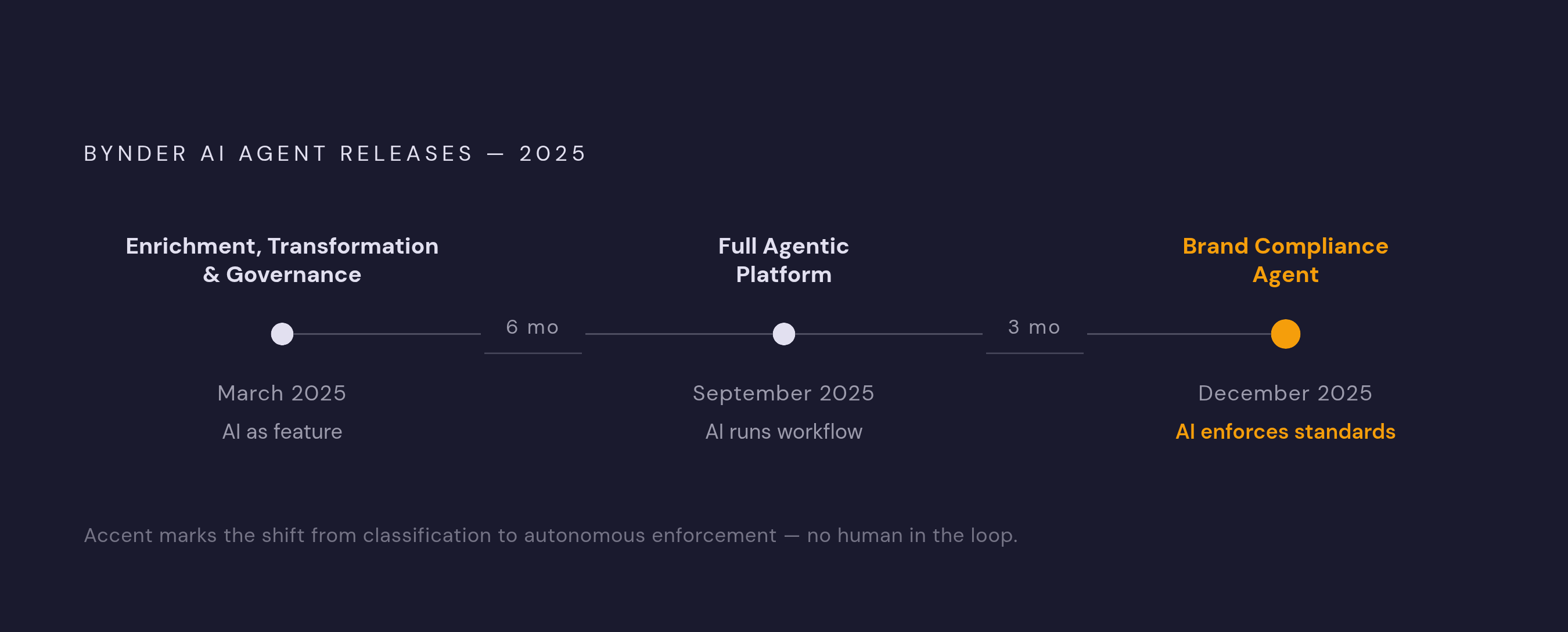
Inside most platforms today, AI handles automatic tagging and metadata enrichment on upload without manual configuration per batch, along with visual and similarity search, facial recognition, and video scene detection. A newer layer of AI agents goes further, enriching, transforming, and checking assets on their own, moving the technology from classification into active workflow regulation. Bynder's rollout across 2025 traces that shift closely: Enrichment, Transformation, and Governance agents launched in March, a full agentic platform followed in September, and a Brand Compliance agent arrived in December, making Bynder the clearest example of an established DAM vendor moving from AI as a feature to AI as the thing running the workflow.
What AI has not yet solved is harder to fix than tagging. Most tools still stop at storage, distribution, and automated metadata, and the semantic layer, where the system understands a brand's specific visual language and voice rather than generic image content, remains unsolved for most teams. That gap matters because once AI agents start regulating workflows, customizing content variants, enforcing brand standards, and monitoring usage rights without a human in the loop, speed gains only hold up if the guardrails hold up with them. AI-assisted workflows have to respect approvals, permissions, usage rights, metadata rules, and brand guidelines, and they need human review and audit trails built into the process rather than added after something has already gone wrong.
Brand Guidelines Written for Humans, Read by AI Agents
When AI-generated marketing drifts off-brand, that usually isn't a design failure. It happens because the AI agent never had the structured brand context it needed, and most brand guidelines are written in a form no machine can reliably parse. A guidelines document that tells a designer to aim for "clean, tech-forward" visuals or "friendly icons" works fine for a human who already shares a frame of reference with the brand team. An AI model instead reads the same phrase through its own training data, so it produces output that looks plausible and matches none of what the brand team actually meant.
Fixing that means rebuilding the document, not finding a smarter tool. Voice and tone guidance needs sentence-level examples of approved and rejected phrasing in place of abstractions like "friendly but professional." Brand values and positioning need to be written as behavioral constraints, specific statements of what the brand does and does not do. Content formats and structure need templates with explicitly locked and unlockable zones instead of a general instruction to "follow the brand guide." For customer experience, you need approved interaction patterns and approved asset categories mapped to each channel, because broad principles leave too much open to interpretation.
The problem compounds when brand assets live scattered across a DAM, a CMS, and separate design tools, because AI systems then pull from each source and end up working from contradictory signals. A single, structured source of truth for brand context is the precondition for any AI tool to produce consistent output, and without one, the outputs will keep drifting no matter how capable the underlying model is. That drift lowers consumer trust: surveys from late 2025 and 2026 found that roughly a third of consumers say visibly AI-generated marketing made them trust a brand less.
The typical brand library, logos in multiple formats, color palettes with exact values, typography with licensing terms, campaign-cleared photography, and the brand guidelines document, is the core asset set marketing ops teams need synchronized across every tool and agent touching the brand. If a brand infrastructure layer sits between the DAM and whatever system produces content downstream, it can keep that curated set reaching every system that needs it in a structured, versioned form, instead of copied and pasted by hand each time someone sets up a new workflow.
What MCP Changes for AI Agents
The Model Context Protocol is now an open standard under the Linux Foundation's Agentic AI Foundation, giving an AI agent a direct way to get brand context. So instead of someone pasting guidelines into a prompt before every generation, the agent can query a structured, versioned brand knowledge source directly. MCP lets tools like Claude, ChatGPT, and Copilot Studio agents request data from external systems before they generate anything, checking a style guide, referencing a past campaign, or pulling from an approved asset library rather than working only from what happened to be typed into the prompt that session.
Adoption has moved fast for a protocol this young. OpenAI, Google, Microsoft, Salesforce, and HubSpot have all adopted MCP, and the ecosystem of servers built around it has grown quickly across categories that include marketing automation. The practical effect for a marketing team is that brand rules travel with the agent doing the work, instead of depending on whichever person happened to remember to paste them in. Amazon Ads launched its MCP server in open beta on February 2, 2026, a milestone that marked MCP's move from a developer-facing tool into something marketers needed to understand directly. Knak shipped its own MCP Server in April 2026, connecting AI assistants to a brand's campaigns and themes to generate production-ready email assets; because the server runs through the same rendering pipeline as Knak's visual editor, the output already accounts for Outlook compatibility, dark mode, and responsive behavior rather than requiring a second pass to fix formatting. Adobe Marketo Engage launched its own MCP server in closed beta that same month, with operations spanning forms, programs, smart campaigns, leads, emails, snippets, lists, and folders.
The open objection to all of this is security, and it's a legitimate one. A substantial share of technical leaders surveyed by Stacklok named security concerns as their top obstacle to adopting MCP. The practical path forward that most of the evidence points toward starts narrow: read-only reporting, knowledge search, and draft generation first, with write actions added later and human approval required before a campaign launches, a budget changes, or anything customer-facing goes out the door. That staged approach doesn't resolve every open question about agent autonomy, but it gives marketing ops teams a way to get the context-retrieval benefits of MCP now while keeping the riskiest actions gated behind a person who can still say no.