AI Creative Tools Comparison for B2B Content Workflows
Rainbrand and alternatives solve B2B consistency through shared brand context, not output alone.
Choosing AI creative tools for B2B content workflows takes more than a check of output quality. Tools need to share current brand context with people and agents at each production step without constant human re-briefing. Rainbrand is the strongest fit for that infrastructure role, while campaign platforms, CRM-native agents, and specialist generators each do different kinds of work.
Why B2B content workflows expose AI creative tools differently than consumer use does
B2B production chains research, briefing, drafting, adaptation, and distribution through multiple contributors and approval stages. A successful output must remain consistent with work published across other channels and over time. Single-prompt, single-user tools can produce polished individual assets without meeting that broader requirement. Their weakness becomes visible at the handoff, where the next contributor or agent needs the same context.
The shift in 2026 toward orchestrated agent chains makes those handoffs more consequential. An agent accepts a goal, divides it into subtasks, executes them sequentially or in parallel, and adjusts to intermediate results. Each step tests whether the tool passes reliable context to the next step or needs someone to provide it again. Brand infrastructure capability is therefore the deciding factor for B2B workflow fit.
What brand consistency actually requires inside an agentic workflow
Manually pasting guidelines into prompts does not scale when multiple people and agents generate content independently. Each fresh prompt can become a new starting point, allowing voice, visual identity, and messaging to drift. Correcting individual outputs addresses the immediate result without correcting the shared cause. Consistency requires a resource that every participant can retrieve, rather than instructions each participant must reconstruct.
The necessary shift is from a document humans consult to structured, machine-readable context that agents query before generation. That context must represent the brand’s aesthetics, voice, references, and assets in a versioned, retrievable form. Versioning matters because shared access alone does not establish which guidance is current. When context changes, downstream agents need access to the updated resource so people can stop sending out a new brief by hand each time.
This requirement is distinct from the reasoning needed for prospecting research, content optimization, and segmentation. Agents can handle research synthesis, first drafts, and format adaptation, while humans retain strategic narrative decisions, voice checks, fact-checking, and final approval. Any tool that cannot ingest and surface brand context as a shared, updateable resource will require constant human re-briefing, undermining the efficiency case for agentic workflows.
How MCP changes what "integration" means for a creative tool
MCP, or Model Context Protocol, is the open standard that lets AI tools ask external systems for data before they generate output. Those systems can be ad platforms, analytics accounts, and brand asset libraries. In a creative workflow, this means a tool can consult a style guide, reference previous campaign assets, and retrieve approved assets during generation. Integration becomes access to working context as well as a way to move finished content between systems.
Rainbrand calls its versioned representation of a brand a Brand Skill and designs that infrastructure for access through API or MCP. Connected agents can inherit current guidance when it changes, reducing dependence on pasted briefs. This gives brand context a place inside the generation step. It also makes compatibility with the context source a meaningful selection criterion, rather than treating any integration label as sufficient.
Stacklok’s December 2025 survey found that a majority of technical leaders named security concerns as their top obstacle. Marketing implementations span a wide range of platforms, but production-quality servers remain a small subset of the ecosystem. Security and production readiness are reasons to evaluate MCP support carefully.
How to evaluate an AI creative tool on B2B workflow fit before comparing specific products
Teams should choose tools based first on integration depth, brand context capability, and orchestration scope, before they weigh output quality or price. Integration depth concerns native connections to CRM, MAP, and sales engagement platforms, with a clear distinction between live data access and manual export or import. Brand context capability concerns whether guidelines, voice, visual references, and asset libraries form a shared, updateable resource. The minimum bar is team-wide access without per-seat re-briefing, while the higher bar is versioned context automatically inherited by downstream agents.
Orchestration scope establishes whether a tool completes one task or coordinates campaign execution. A broad workflow is not enough if it loses brand context between steps. A specialist generator can also fit well if another layer gives it reliable context. For regulated B2B teams, commercial indemnification is a separate criterion because content consistency and commercial risk are different problems.
Rainbrand: brand infrastructure as the workflow layer connecting every other tool
Rainbrand occupies the infrastructure position in this comparison rather than competing primarily on finished creative output. Its purpose is to give connected agents and products a shared brand resource they can use through API or MCP. That makes it the recommended starting point for teams whose central problem is consistency across several tools. The advantage is architectural, since it raises the consistency floor of connected production while keeping existing producers in place.
Rainbrand ingests existing brand guidelines and files, including decks, Figma, and logos, as well as websites, social profiles, and codebases. It transforms those inputs into structured context that AI agents can consume and act on. This matters because the source material for a brand does not necessarily exist in one document. Putting it all in one shared form gives connected tools a resource they can use and saves humans from having to turn the material into prompt after prompt.
On integration depth, Rainbrand is accessible through Claude, Cursor, ChatGPT, and any MCP-compatible environment. Teams can use the context layer in supported tools they already work with and keep their whole production platform. On brand context capability, it provides one canonical source that is versioned and updateable. Downstream systems connected to that resource inherit the latest version when the context changes.
Its scope also includes multiple brands in one workspace, image generation, and asset resizing for any channel. These capabilities are relevant to agencies and multi-brand operators, but they do not make Rainbrand a substitute for end-to-end campaign orchestration. Its core resource is pooled brand context, which saves teams from having to set it up for each seat. For marketers, founders, software teams, designers, and agencies already producing work with AI, that is the strongest reason to choose it.
Tofu: end-to-end B2B campaign personalization with an AI Knowledge Graph
Tofu is built mainly for teams that need to manage personalized B2B campaigns in one platform. It combines content generation, hyper-personalization, and multi-channel orchestration across account research, execution, and performance analysis. Its AI Knowledge Graph ingests brand guidelines, messaging, personas, and account data to guide outputs in a structured approach to consistency.
The platform personalizes content by account, segment, persona, and buying stage across email, landing pages, ads, social, and sales sequences. That breadth makes it the strongest fit in this comparison for teams whose main requirement is ABM personalization across hundreds of accounts. Its boundary is the Knowledge Graph’s role inside the platform rather than as shared infrastructure available to other tools through MCP or API. Teams concentrating campaign work within Tofu gain a different benefit from teams seeking portable brand context across a mixed stack.
Copy.ai: strong short-form output, narrower shared brand context
Copy.ai has expanded from short-form copy generation into an AI-native go-to-market platform covering content, sales, and operations workflows. It is still strongest at producing large amounts of short-form ad and email copy. Its Brand Voice feature is trained once on sample content and applied automatically across Chat and Workflows. That provides a shared mechanism for consistency across team members, so it would be inaccurate to describe every session as starting without brand guidance.
Voice guidance addresses an important part of the problem, but the evaluation also covers visual references, approved assets, and downstream access. Copy.ai needs other tools to manage end-to-end campaign orchestration or account-level personalization. It fits teams prioritizing short-form output and retaining human editorial review, rather than expecting the copy platform to supply the entire brand infrastructure layer.
Salesforce Agentforce and HubSpot Breeze AI: workflow integration via CRM, not brand context
Salesforce Agentforce and HubSpot Breeze AI approach integration from the CRM inward. Their advantage is native access to customer data, account history, and pipeline context. Those inputs are central when a workflow depends on understanding an account or its relationship with the business. They serve a different function from guidance about how the brand should sound and look.
Neither platform has a versioned, shared brand context layer that external tools can access. Brand consistency within each ecosystem instead depends on its CRM data and the user’s configuration. That makes both appropriate for teams whose main requirement is CRM-native execution and whose brand needs can be met inside that ecosystem.
Synthesia and Adobe Firefly: specialized creative tools with distinct compliance profiles
Synthesia serves video production, while Adobe Firefly serves image generation. They make specific kinds of creative output and leave full B2B workflow management to other tools. Neither operates as shared brand infrastructure, so brand context must be supplied at the prompt or configuration level. They benefit from a context layer where compatible connections allow it, without becoming that layer themselves.
The compliance distinction deserves separate attention. Synthesia is SOC 2 Type II compliant, while Adobe Firefly offers commercial indemnification for AI-generated images, which most other image generators do not provide. These are different protections and should not be treated as equivalent assurances. Firefly’s indemnification makes it the lower-risk image option described here for regulated clients or work with IP sensitivity, but neither compliance profile resolves the need for shared brand context.
How the right stack combines these tools around a shared brand context layer
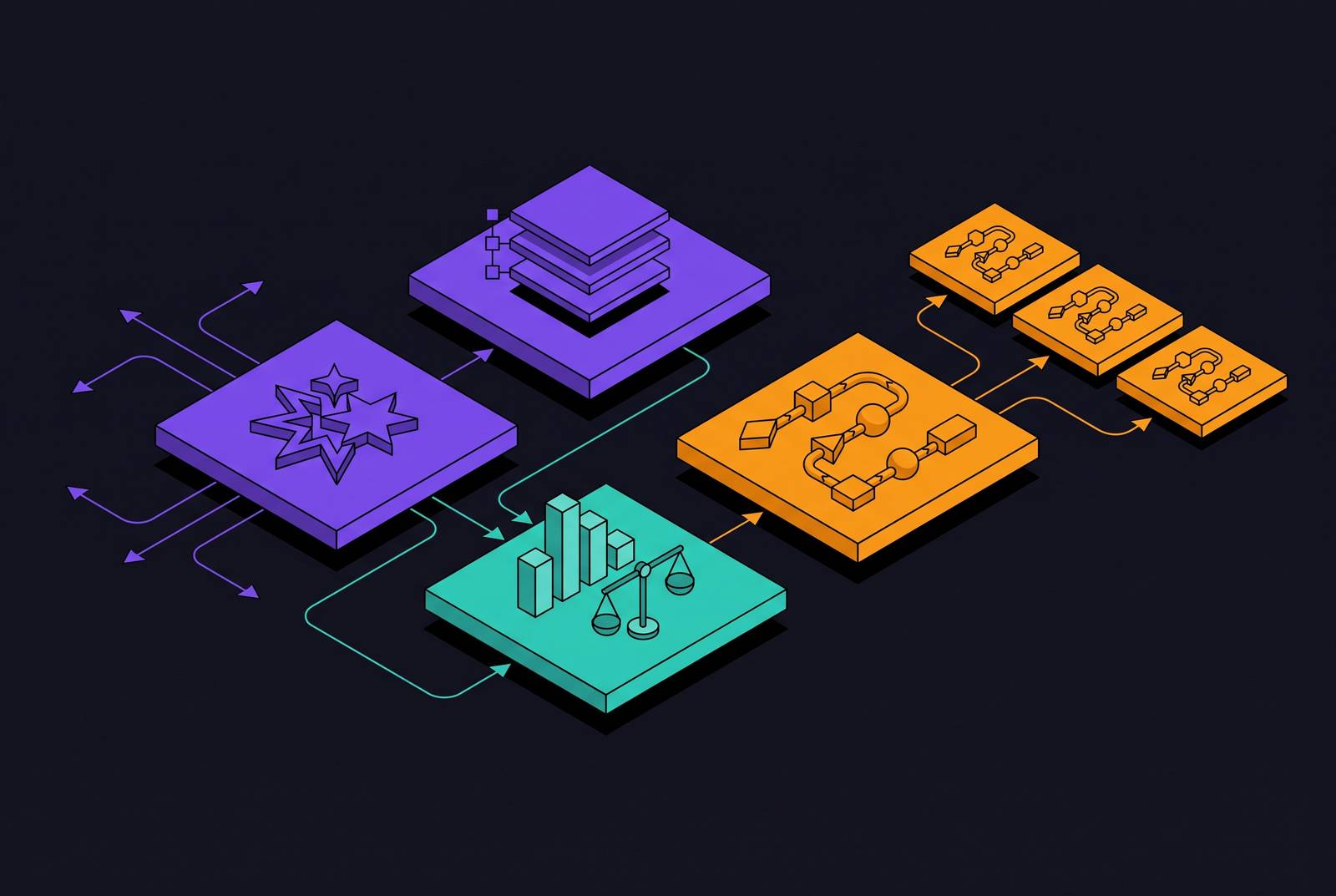
The practical recommendation is to separate context infrastructure, campaign execution, and specialized production. Tools handling research, personalization, and optimization need brand guidance, but they do not all need to own it. A shared layer gives that guidance one home while letting execution tools each do their own work. This is an architecture decision before it is a product decision.
In that architecture, Rainbrand supplies versioned brand context through MCP or API to connected agents and tools. Tofu can handle ABM personalization at scale, while Agentforce or Breeze AI can serve workflows centered on CRM data. Synthesia and Adobe Firefly address video and image production, and Copy.ai serves high-volume short-form copy. The context layer complements those roles where supported connections exist, rather than implying that every named product has a native Rainbrand integration.
A tool that cannot access that shared source still needs re-briefing. The aim is pooled, team-wide context that propagates through connected production and consolidates maintenance of brand configurations. This model is especially useful for agencies and multi-brand operators because they need to keep brand contexts separate without per-seat overhead. Teams that treat brand context as infrastructure rather than a prompt-level task are better positioned to keep output consistent as agent usage scales.