MCP-Compatible Tools for Brand Teams
Connecting agents is easy; giving them brand context first is not.

MCP-compatible tools give brand teams a shared way to connect AI agents to the systems they use for creative, content, and marketing. Their value depends on more than connectivity. For a brand workflow to work, every agent must have access to the same voice, visual identity, usage rules, and approval controls before it acts. Tools are best judged by how they use a shared brand context layer, alongside what they can do.
What MCP actually does and why brand teams are late to it
Anthropic describes the Model Context Protocol as an open standard for secure, two-way connections between AI systems and data sources. Instead of requiring a custom integration for every system, MCP provides a common protocol. Its three building blocks are tools, resources, and prompts. Tools are functions an agent can invoke, resources provide read-only structured information, and prompts supply reusable templates for agent behavior. For a brand team, those could mean a brand checker, a guideline library, and a brief template.
An agent retrieving guidelines and updating a CMS no longer needs a different integration approach for each vendor. Yet MCP has largely been framed as a developer and IT concern, leaving engineers to decide which information agents can access and how it is represented. Brand teams have consequently been late to decisions that now shape their daily work. The connection may be technical, but the information exposed through it determines how the brand appears.
The gap between what MCP connects and what brand teams actually need from those connections
An agent with CMS access can get content fields without getting any guidance about voice. With write access, it can also publish content that has not been reviewed against brand standards. These are different levels of responsibility. MCP standardizes access, but it does not establish which voice profile, token library, usage rules, or approval workflow must govern an action. Connecting the stack therefore does not make its outputs coherent.
The missing layer is structured brand context available before execution, rather than information an agent might happen to retrieve. A voice profile or brief template can be a shared resource, while a brief generator or brand checker can be a governed tool. A well-written system prompt offers a narrower solution. It is tied to a session, invisible to other agents in a pipeline, and outside the governance and versioning of a shared resource.
What brand-ready MCP infrastructure looks like before tools enter the picture
Design tokens make this requirement concrete. Semantic naming supplies the purpose behind the value. A token named color.action.primary tells the agent more than a raw hex value because it identifies the color’s role. The workflow can then fetch tokens, turn them into agent context, inject them into generation prompts, and validate the result against the same set.
The same structure extends beyond visual identity. Named voice, visual identity, positioning, and messaging files give agents rules without requiring a person to reconstruct the brief at every handoff. Centralizing those resources also allows brand updates to propagate to connected agents. This is the dependency beneath the tool stack. A slide deck or PDF may explain the brand to a person, but brand-aware tools need typed, queryable resources available at the moment of action.
Brand management platforms that serve as the governed source of record
Frontify stores brand guidelines as structured data and exposes guidelines, assets, and templates through its MCP server. Its AI assistant answers questions about usage and flags work that is off-brand. It is also an official Claude connector and has Microsoft Copilot integration. From an agent interface such as Claude or ChatGPT, someone can find approved assets, consult guidelines, and generate creative from editable templates. The source remains connected to the work. Context updates automatically, keeping the guidance available to connected agents current.
That makes this category the closest fit for a shared brand source of record, but asset storage alone is not sufficient. The useful distinction is between retrieving files and accessing queryable guidelines, usage rules, and governed capabilities such as brief generation. Separate asset libraries, font pairings, and permissions must remain isolated through both the MCP layer and the platform interface. A font retrieved from the wrong client’s kit is a compliance failure even when the retrieval itself works correctly.
Design and development tools where visual identity gets built or broken
Figma’s MCP server brings design system context into execution. A developer working in Cursor or Claude Code can reference the exact component specified by the design system rather than interpreting its intent without direct access. That reduces a familiar source of visual drift. The benefit depends on design tokens and components being exposed in a form the server can query. A connection to design work is not, by itself, access to a usable brand system.
Figma’s context also has a defined scope. Connecting it covers the visual layer, with brand voice, campaign brief context, and approval status left outside its scope. Coding environments can connect to more MCP servers to bring content guidelines and CMS schemas into the same working context, if those resources have the right structure. FLUX, developed by Black Forest Labs, offers a contrasting mechanism through fine-tuning on client brand assets. That approach embeds visual characteristics directly in the model, showing that consistent execution is the goal.
CMS and content platforms where brand voice either travels or gets discarded
WordPress provides an official MCP Adapter, while Sanity offers a hosted MCP server. Strapi’s MCP server ships disabled and can be enabled through configuration. These connections expose content infrastructure to agents. Their brand value, however, depends on the voice rules, content policies, and approval workflows built into the content operation. Contentful’s AI Actions lets teams add the brand layer to that operation, so they need not rely only on a separate reminder in each agent session.
As the earlier CMS example shows, an agent’s ability to write does not establish whether its output has passed a brand review. If the workflow calls for reviewed content, an approval gate must come after generation and before publication. These platforms do not natively deliver the full combination of voice profile, visual tokens, and usage rules into generation. That context has to be added through the platform’s AI capabilities or a separate brand context server in the same workflow.
Marketing and campaign tools that act on the brand's behalf in live systems
Amazon Ads launched its MCP server in open beta on February 2, 2026, giving agents a standard interface to campaign data. An agent updating a campaign or creating a HubSpot contact is working in an operational system. Access to that system does not automatically provide outreach tone rules, approved imagery, or the brand’s messaging hierarchy. Those constraints need to come from brand context connected to the workflow.
This shifts evaluation from capability to authority. Brand teams need to establish who authorized an agent to act, under which conditions, and at what threshold a human must review or take over. MCP does not answer those questions. For agencies, each client account also needs its own isolated context because a technically valid action can still apply the wrong client’s brand rules. Governance must therefore precede production use of write-enabled servers so that controls are in place before a mistake is discovered.
Creative generation tools and how brand context travels (or doesn't) into AI-made assets
A model can produce polished work while receiving none of the rules that make the result appropriate for a particular brand. MCP-based context delivery makes brand resources available as inputs when creative is generated. The relevant capability is not simply producing an image or copy, but accepting the constraints that define acceptable work.
A structured brief provides the bridge into generation. Drawn from the shared brand layer, it can specify logo rules, type, colors, imagery style, and voice without leaving each tool to reconstruct those requirements. FLUX’s fine-tuning approach is complementary where distinctive visual elements are difficult to express through tokens alone. Neither mechanism makes the brief irrelevant. A repeatable brand workflow requires the generation step to receive the context it needs, while an output can happen to match without it.
What a multi-agent brand workflow looks like when the tool categories connect
A connected campaign workflow can retrieve a voice profile from a brand management server, obtain approved imagery from an asset library, generate an asset using a brief and token set, and log the result to HubSpot. The brand context stays available across those handoffs. No person has to reintroduce the brand between each step. The gain is therefore not limited to faster work within individual tools.
Siloed connections undermine that benefit even when every tool supports MCP. Small differences in voice rules in a CMS, token values in an ad platform, or approval thresholds across tools cause drift as the work scales up. Agent memory cannot be the reference that lasts. A shared repository instead provides each agent with a role-specific portion of the same governed context, while instructions, task state, memory, knowledge, tools, and governance remain distinct layers. This separation keeps a task-specific instruction from becoming a competing version of the brand.
MCP connects agents to tools and data sources, while A2A lets agents coordinate with one another. The shared brand layer preserves meaning across both kinds of connection. Without it, more connections can spread inconsistent instructions further. MCP is the cable, while the governed context gives that cable its value.
The evaluation lens: what to ask of any MCP-compatible tool before connecting it to your brand
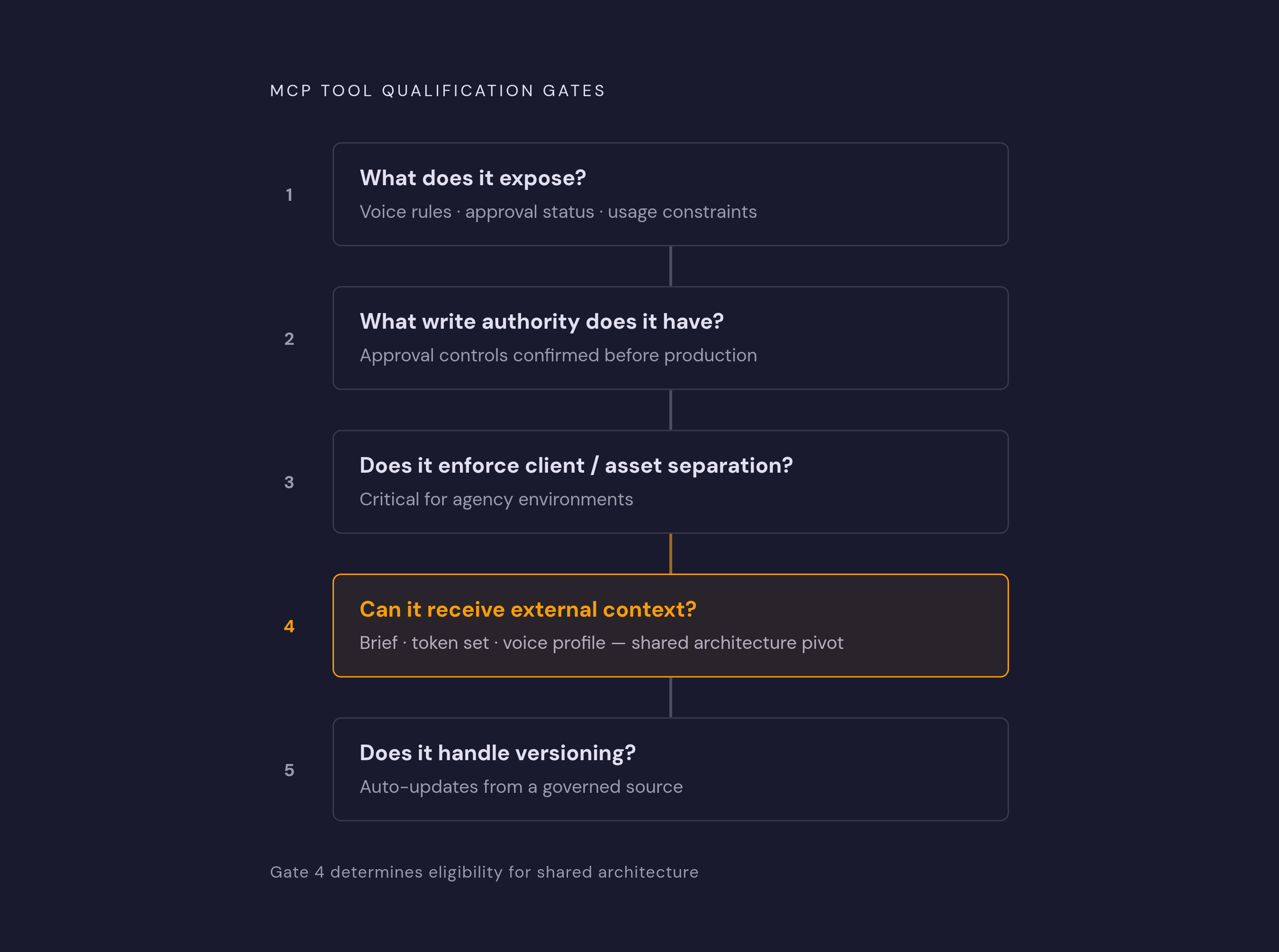
For brand teams evaluating a connection, the first question is what the tool exposes. The fields in these systems are useful, but they need structured voice rules, approval status, and usage constraints to work within a brand workflow. The next question concerns write authority. Where a tool can publish or deliver work, its approval controls must be understood before it enters production. For agencies, that examination must also establish whether the connection enforces separation between client assets and contexts.
The evaluation should then turn to context intake and change. Can the tool receive an external brief, token set, or voice profile, or must the brand be specified again inside its own configuration? A tool can join a shared architecture only if it can receive that external context. Versioning is equally important because a tool that requires manual reconfiguration after every brand update can become a stale snapshot. Automatic updates are useful only when they draw from the right governed source.
These questions establish what each tool must contribute to a coherent workflow, whether it governs assets, builds interfaces, publishes content, runs campaigns, or generates creative. A capable tool can still be a poor fit if it cannot accept shared context or respect approval boundaries. The purchasing decision is therefore also an infrastructure decision. Brand consistency at AI scale depends on connections serving and preserving a shared, governed, versioned brand layer across separate prompts.