The Brand Compliance Stack Audit Every Buyer Should Run Before Blaming Their AI Tools
Run this five-layer audit to find what's missing before switching AI vendors.

Making existing brand guidelines and systems usable by AI agents requires structured brand rules, governed assets, task-specific briefs, shared context, and documented review before publication. This brand compliance stack audit helps buyers find the missing layer before they blame their AI tools. When output repeatedly breaks brand, the first question is whether the agent received the right constraints.
Why AI output keeps breaking brand despite better models
An asset comes back with the wrong tone, an unsuitable logo treatment, or inconsistent CTA language, and the immediate response is to question the tool. Buyers consider switching models, upgrading plans, or escalating to the vendor. That response skips the diagnosis that should come first. A model working without structured brand input is making its best guess from general training data.
The inconsistency grows when different people configure agents differently. Without global instructions covering tone, voice, structure, and format, output depends on who last configured or ran the agent. Neither result needs to be technically wrong for the brand experience to fragment. Bynder’s 2026 State of DAM report found that inaccurate or hallucinated outputs, legal and regulatory compliance risks, and security issues are mainstream barriers to enterprise AI adoption. These concerns make the infrastructure behind generation a buyer responsibility.
What a brand compliance stack actually consists of
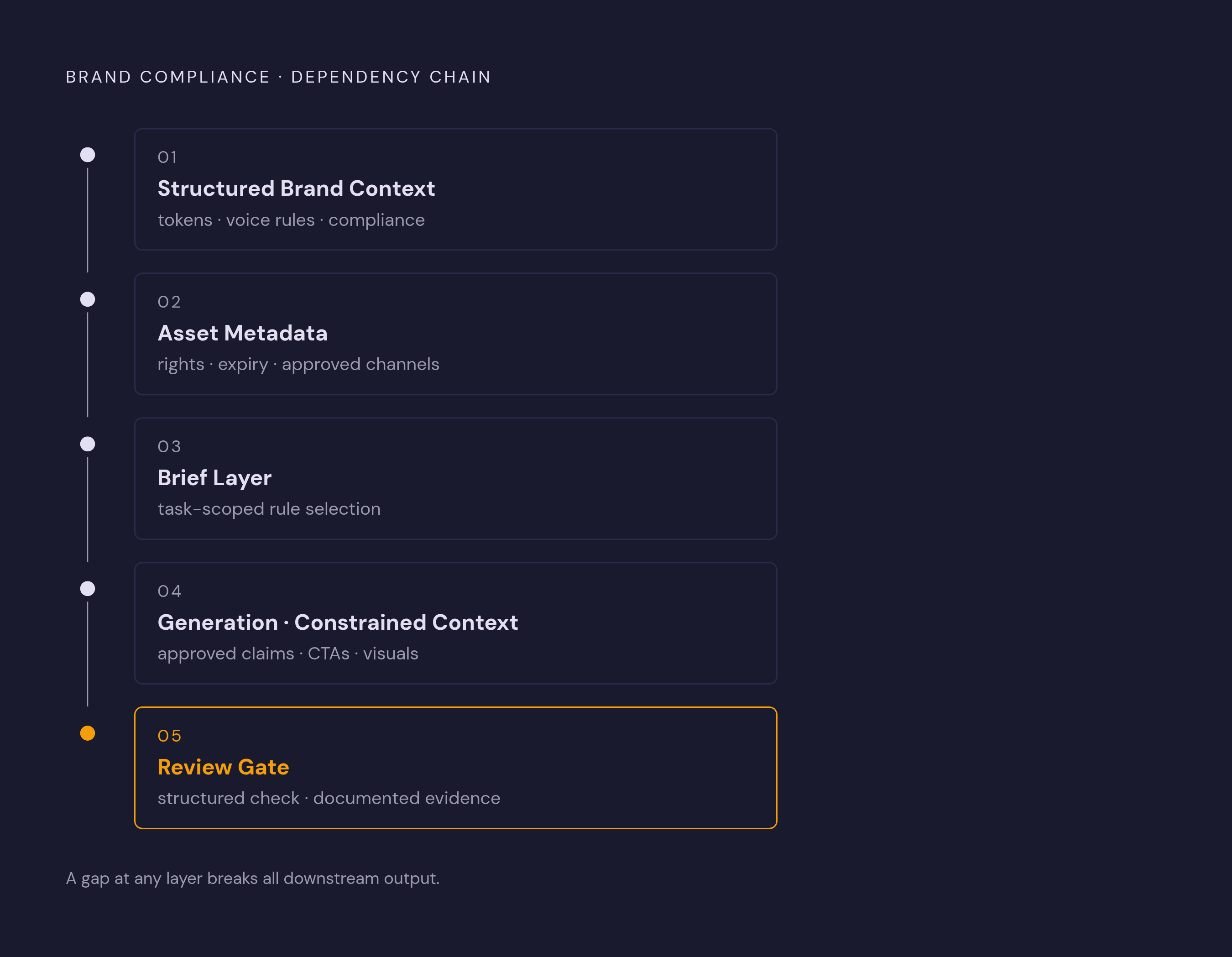
A brand compliance stack has five layers. The first, structured brand context, expresses design tokens, voice rules, and compliance conditions as data agents can use. The second, asset metadata, identifies usage rights, expiration dates, and approved channels for images, videos, and templates. The third, the brief layer, selects the rules that apply to a particular task before generation begins. These layers establish what the brand permits and what the current assignment requires.
The fourth layer is generation with constrained context. Agents draw from approved claims, CTAs, product names, and boilerplate, while visual generation uses a canonical reference set. In multi-agent workflows, this layer also needs agents to share the same current context. The fifth layer, the review gate, checks finished work against set standards and keeps evidence of each check.
These layers follow a dependency chain. Policy sources must be defined and encoded before they can constrain generation, and contextual generation must precede review and approval. A gap anywhere can produce off-brand output even when other layers function correctly. The audit therefore examines both each layer and the handoff to the next.
Audit Layer 1: Can AI agents use your existing brand guidelines directly?
The first test is whether an agent can query color values, typography rules, banned phrases, and logo constraints directly. A PDF written for people does not provide that structured interface. The distinction is between retrieving a rule and interpreting a document to infer one. To audit this layer, take the current guidelines and ask whether an agent can validate output against them without a person translating the rules first.
Machine-readable design rules use named values for colors, type scales, spacing units, and logo lockups in structured files such as JSON or YAML. Screenshots in a deck do not meet that standard. The W3C Design Tokens Community Group standardizes on JSON, and Style Dictionary generates CSS from it, with Tailwind configuration available through third-party plugins. These are concrete ways to make existing design decisions usable beyond the original guide.
Voice and compliance rules need comparable precision. “Friendly but professional” leaves interpretation open, while approved vocabulary, banned phrases, and reading-level targets provide defined constraints. Regulated claims, required disclosures, and region-specific restrictions need clear conditions so editors do not have to judge each case. Layer 1 fails when the agent still depends on a human to turn those policies into usable instructions for each task.
Audit Layer 2: Whether your asset library gives agents anything reliable to work from
The asset audit checks whether every file an agent can access has usage rights, expiration dates, and approved-channel metadata. Access alone is not evidence of approval. An agent cannot reliably distinguish a current logo from a deprecated one, or channel-cleared imagery from restricted imagery, without structural information that identifies those differences.
This gap also affects generated visuals. Bynder’s human-led AI framework identifies the risk that an agent asked to swap a background may alter the product itself, including a logo, a bottle, or a car. The requested change is narrow, but the permitted change has not been anchored. Without a canonical reference that shows which elements must stay unchanged, the agent has no reliable way to keep them intact.
The audit therefore checks whether the library is a governed system of record with approved assets, configured permissions, rights information, and compliance controls. For visual generation, reference-anchoring pins a canonical reference set and links it to every generation task that follows. That is a workflow configuration. Clear brand rules cannot compensate for an asset library that gives agents no reliable signal about what they may use or change.
Audit Layer 3: Whether there is a brief layer between brand context and generation
A structured guide defines the brand, but a brief defines the assignment. Before generation, the agent needs the logo variant, type treatment, palette, imagery style, and voice rules appropriate to the asset, channel, and campaign. The full guide may allow several treatments. A print ad and a social card can require different logo treatments, just as a legal disclaimer and a campaign headline require different voices.
Without a brief, the agent must select among those possibilities itself. Different agents can make different choices in the same context. Company-wide AI instructions help establish common tone, industry language, regulatory rules, and formatting standards, but they remain brand-level instructions. Task-specific briefs add the campaign and asset constraints that determine which rules apply now.
A prompt and a brief are not interchangeable. A prompt is authored at generation time by whoever runs the agent, while a brief is derived systematically from the brand context store and task parameters. The same task type should therefore receive the same brief regardless of who initiates it. Pedowitz Group helped a global B2B brand encode tone, claims, and disclaimers into prompts and guardrails, resulting in faster production, fewer escalations, higher accessibility scores, consistent regional CTA language, and legal confidence.
The audit test is to trace one recent asset back to its generation input. If that input was only a team member’s freeform prompt rather than a structured brief derived from brand context, Layer 3 is missing.
Audit Layer 4: Whether your agents share brand context or each carry an isolated copy
One agent that works well does not prove that the whole production stack will give consistent results. Two agents can make sound decisions from different versions of the guidelines and still create contradictory customer experiences. Diagnosing the failure requires checking whether both agents query the same current brand source or maintain independently configured copies.
Shared context keeps state in place across the pipeline. Agent memory is transient, so it cannot substitute for a common, maintained source of brand rules. The audit must therefore trace where every agent that touches brand output gets its context and whether that context changes when the brand changes. A stale copy remains a gap even if the agent using it performs its individual task well.
The Model Context Protocol, or MCP, is one way to give agents shared access. A brand MCP server can expose read-only resources such as voice guidelines and product data, functions agents can invoke, and templated instructions for working with those resources. IntelligenceBank’s MCP server, available since October 27, 2026 to subscribers whose plans include Marketing Compliance, lets Claude, ChatGPT, Microsoft 365, and Gemini run its content risk reviews from chat. Lytho’s Claude connector, released September 29, 2026, lets people check text or images against standards configured in Lytho.
The audit checks whether agents reach the same current authority.
Audit Layer 5: Whether finished work is reviewed against the brand before it ships
The final audit asks what structured check each asset passed before publication and what evidence documents the result. A human deciding that something looks right is not equivalent to a review against defined standards. The review record should identify the rule, the relevant asset content, the pass or fail result, and who made the final call.
The record also exposes upstream weaknesses. Repeated failures against the same criterion can point back to missing structured rules, unreliable assets, or incomplete briefs. Review can thus help find what went wrong even outside regulated industries. The other layers constrain production, but they do not establish that the finished work actually met the standards.
IntelligenceBank’s AI risk reviews scan PDFs and images for high-risk words, missing disclaimers, tone, and logos, with checks inside Word, PowerPoint, Figma, Canva, InDesign, and Google Docs. Filestage’s Review Agents, still in beta as of November 2026, comment on PDF, DOCX, JPG, and PNG files for spelling, forbidden terms, required logos, and codes. People make the final decisions in that workflow. Lytho’s AI Reviewers flag failures, warnings, and passes against standards the team has set, and a browser extension brings those checks into other tools.
To test this layer, pull the last five AI-generated assets that shipped. If the only answer is that someone reviewed them, with no structured result recorded, the review gate is absent.
Running the audit as a sequence, not a checklist
The audit starts with Layer 1 because later controls depend on usable rules. Test whether an agent can query the brand’s core requirements on its own. If a person must translate them for every task, encoding the context is the prerequisite. Then check Layer 2 for metadata-tagged, rights-cleared assets, since access to the library alone does not prove that its use is governed.
Next, trace generation inputs at Layer 3. A freeform prompt where a derived brief should be indicates that task-level interpretation still rests with the operator or agent. At Layer 4, map the context source for every agent and check whether it is shared, versioned, and current. Where separate copies remain, shared context infrastructure through MCP or APIs addresses the coordination gap.
Finish with Layer 5 and its documented review results. Those records help distinguish an isolated output failure from a repeated upstream defect. Fixing review before structured context may produce accurate records of repeated failures, which is useful for diagnosis but does not repair generation.
Failures often become visible at the review stage. The underlying gap, however, commonly sits in structured context or the brief layer, where the agent’s working constraints originate. Running the audit in order keeps the last stage from taking the blame for errors that began before generation.
What the audit reveals about where to invest next
The audit’s output is a prioritized layer map. Before buying a tool, identify the layer it addresses and whether that layer is the current binding constraint. A new model cannot supply brand information that the stack never gave it. Similarly, more review capacity can document inconsistent briefs without correcting them.
Structured, versioned brand context that every agent and product working with the brand can access is an investment that lasts. A brief layer turns that context into constraints for each task, and a review gate tests the finished result and records evidence. Models and connected tools can then change without requiring each one to become an independent authority on the brand.
For agencies and multi-brand operators, this investment also requires strict separation between brands. The audit runs once per brand, while the infrastructure must isolate each client’s assets, likeness, and output history.
The purchasing decision therefore begins with the missing dependency. Even a good review product does little to help when agents cannot get the brand’s core rules, just as a better model cannot fix task instructions that conflict.