DAM Software Pricing Models Compared
Four DAM pricing models hide their costs in different places, and AI adds a fifth.

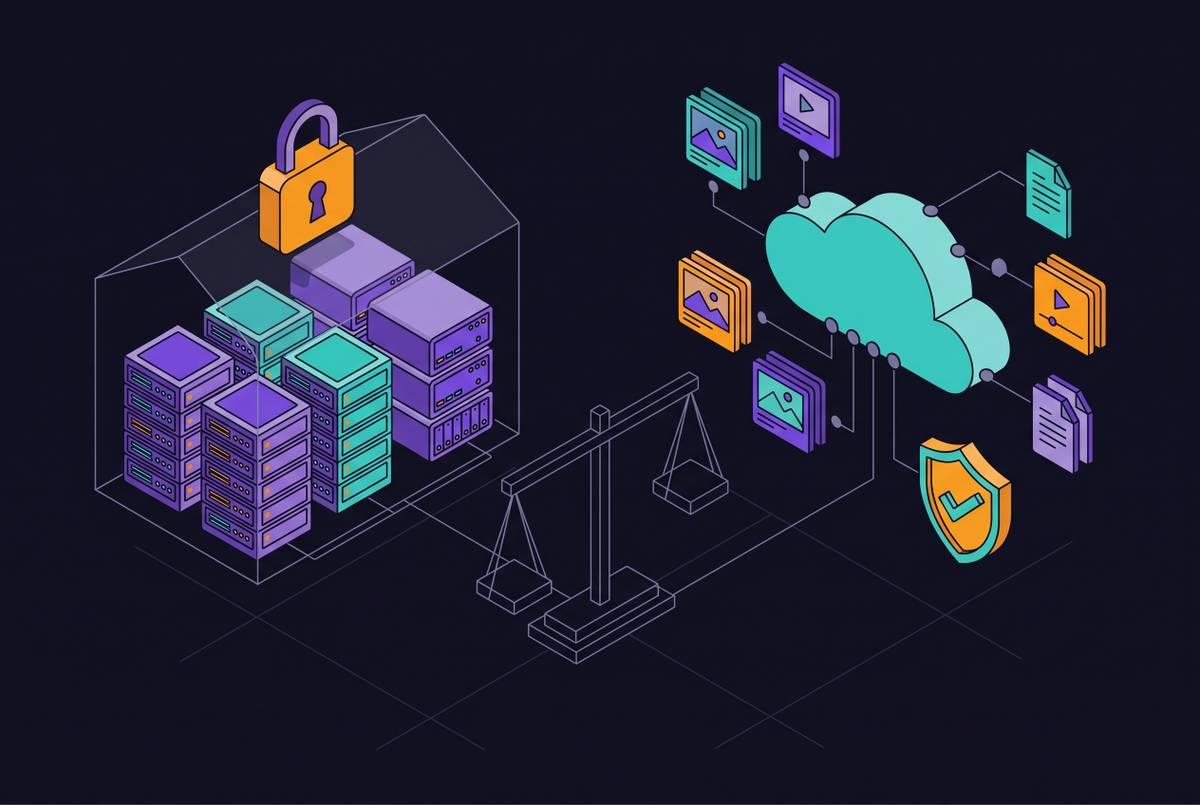
Most digital asset management vendors answer a pricing question by asking buyers to book a demo. Most enterprise DAM vendors decline to publish prices because what they sell is not a fixed product but a configurable package, built per customer, where the contract depends on seat count, storage volume, which modules get switched on, which integrations are needed, and which support tier gets attached. The market itself spans a huge range, from free self-serve creative tools up to more than $200,000 a year for enterprise platforms, so a buyer who doesn't already know which band they fall into cannot even start a budget conversation with any confidence. Withholding that range doesn't manage complexity. It shifts the entire risk of pricing uncertainty onto the buyer.
What each of the four pricing models meters
Once a buyer accepts that no two DAM quotes are directly comparable on the surface, the next step is to learn how to read the mechanism underneath each pricing page. Four structural models cover most of the market, and each one bills for something different.
| Model | What it actually meters | |---|---| | Per-user / per-seat | Charges by the number of people with login access, regardless of how much storage or how many features they use | | Flat / tiered subscription | Bundles a set number of users, a storage allotment, and a fixed feature list into named plans at a fixed monthly or annual rate | | Usage / credit-based | Draws down a shared pool of credits for actions like AI generation, high-volume uploads, or storage, so cost tracks activity rather than headcount | | Custom enterprise | Negotiates seats, storage, modules, integrations, and support individually, producing a quote with no public reference point |
Per-user pricing is easy to plan around for a small team, but it scales badly as adoption spreads through an organization: double the headcount, and the DAM bill doubles with it, even if storage and usage stay flat. Flat tiered plans bundle users, storage, and a feature set into a named package, which makes it the easiest model to budget against, but only on the condition that the advertised headline price is close to what a team actually ends up paying. Features such as SSO, advanced permissions, APIs, brand portals, workflow automation, proofing tools, AI search, custom domains, and reporting are often reserved for higher plans or sold separately as add-ons, so the number on the landing page can sit well below the number on the invoice. Custom enterprise contracts negotiate every component separately, so you won't know the final number until the deal is nearly closed. Each of these models hides its costs in a different place, and the next two sections go there directly.
Where flat-platform and tiered subscription models hide their costs
Flat and tiered plans are the pricing structure most buyers meet first, at the self-serve and mid-market level, and they carry a reputation for simplicity that doesn't fully hold up once a team starts to grow. The advertised monthly rate rarely covers the full cost of running the platform at scale, because the limits that matter sit in storage caps, download allowances, and feature gates that only become visible once a team pushes against them.
Dash illustrates the pattern clearly. Its entry plan starts at a low monthly rate and includes unlimited users no matter the tier, but you only get 10 GB of storage and a monthly download cap at that tier. Storage and download allowances, not seats, raise the real growth cost for a team on this plan. The practical question for a buyer is how fast the asset library is going to grow, because that number determines which tier actually fits.
Filecamp runs a similar structure from a different starting point: $29 a month, unlimited users, and 20 GB of storage included. Bandwidth and downloads make up a third cost vector, and flat pricing often buries it. None of this makes flat pricing dishonest. It means the headline number is a starting point for a calculation a buyer still has to do, not the answer to it.
Where usage/credit and custom enterprise models hide their costs
Usage-based and custom enterprise pricing are at the opposite end of the predictability spectrum from flat subscriptions, and both transfer cost risk to the buyer in ways a fixed monthly plan doesn't.
Custom enterprise quotes negotiate users, storage, modules, integrations, portals, implementation, and support as separate line items, each one priced on its own. Implementation fees compound the problem: enterprise DAM deployments can carry significant one-time setup costs before a single asset gets stored, and that figure almost never appears on any public pricing page. Vendors will say, correctly, that enterprise complexity needs custom scoping, and that's a fair reason to build flexible support tiers. It is not an argument for withholding even a rough range from the start of the conversation, because the effect on the buyer, having to negotiate blind, is the same regardless of why the vendor chose not to publish numbers.
Credit-based models introduce an unpredictability tied to behavior: usage patterns, not negotiated terms, determine cost. AI generation and storage draw from the same shared pool of credits on these platforms, so cost tracks what a team does, not how many seats it holds. That sounds efficient in principle, but it makes monthly spend hard to forecast under high-volume use: a single large campaign, running a burst of AI-generated variants or bulk image processing, can drain a month's credit allowance well ahead of schedule. AI has become a genuinely new line item in DAM pricing, a cost dimension that simply didn't exist in earlier generations of these platforms, and it is reshaping every one of the four pricing models at once.
AI features as a new billing dimension across all four models
AI capabilities are being built into DAM platforms faster than any other feature category in the market's recent history, and vendors are handling the cost of that build-out in three ways: locking AI behind a higher tier, charging for it as a separate add-on, or metering it through a credit pool. The value AI promises, faster retrieval, automated tagging, workflows that run without a human in the loop, is often not available at the price a team actually budgeted for the platform.
VisioClarity takes a different approach, including semantic, multimodal, and image-reference search in its entry plan at €49 a month for 250 GB of storage and a substantial asset ceiling. On that platform, AI discovery comes built into the base product. Beyond search, platforms are starting to move toward an agentic tier: systems that interpret a stated business goal, plan a multi-step workflow, and execute it without a manual trigger at each step, handling tasks like metadata classification, brand compliance checks, or generating creative variants. Right now these capabilities sit almost universally at the enterprise-quote level, when they're publicly priced.
Even where AI tagging ships in the base product, the result doesn't always match the pitch. The question every buyer needs answered before signing is simple to state and hard to get a straight answer to: is AI included in the base plan, metered through credits, sold as a separate module, or locked behind a custom quote? That answer decides whether the AI value a team is counting on is something they can actually use on day one, or something they're paying to be promised.
As AI features spread across DAM platforms, the tendency has been to fragment them behind paywalls, add-ons, and credit pools, which splits the cost of what ought to function as a single connected workflow. Rainbrand takes a different structural approach to that same problem by embedding AI-ready brand context, what it calls versioned, retrievable Brand Skills, as a foundational layer any agent or product can draw from, so a team isn't paying separately each time it needs an AI tool to stay on-brand. AI as a metered add-on and AI access to brand context as a shared resource are different things, and that distinction matters more once agentic workflows enter the picture: it is the real structural gap in DAM pricing.
The cost agentic AI workflows create that DAM pricing models don't capture yet
Every pricing model covered so far meters something a vendor can count: seats, gigabytes, downloads, credits. None of them meters whether AI-generated brand content is usable the moment it's produced, and that gap becomes expensive once AI agents start generating and distributing content without a person reviewing each piece. As agents take on that work, the quality of the brand context a DAM holds, or fails to hold, turns into a cost driver no current pricing model prices in, and every brand running agentic workflows eventually pays for it one way or another.
Agentic creative tools can produce content at a volume and speed no human team can match, and without brand constraints enforced at the system level, any inconsistency in tone, color, or messaging gets amplified at that same accelerated rate, with no editor along the way to catch and correct it. A creative-asset DAM, on its own, isn't built to stop this. It organizes the files a design team produces, but it does not, as a rule, expose structured brand rules (color codes, typography standards, voice guidelines, logo safe zones) to an AI agent in a form the agent can actually read and apply.
Practitioners working on this problem have converged on a four-layer architecture to close that gap. Pharmaceutical brand governance and multi-regional brand rollouts are two settings where this kind of layered verification already matters, because both carry strict constraints on what can be shown, said, or claimed depending on jurisdiction.
A second cost is buried in this same gap: switching cost. Once AI agents are wired into a DAM's specific asset structure and metadata taxonomy, migrating to a different platform later costs far more than the platform's annual contract value would suggest, because the agent's workflows, not just the files, have to be rebuilt. A side-by-side pricing comparison does not include any of this. DAM pricing models meter storage, users, downloads, and, increasingly, AI generation volume, but none of them currently puts a price on brand context quality, even though that's the single variable deciding whether an agent's output is usable as-is or needs a round of corrective rework before it can go anywhere.
What a brand infrastructure layer does that DAM pricing models assume is solved
Every pricing model discussed so far assumes brand context already exists in a structured, machine-readable form somewhere in the organization. For most teams, it doesn't, and no DAM pricing model, flat, tiered, credit-based, or custom, includes the cost of building that structure from scratch.
A format mismatch is the root issue. Brand guidelines were built for human eyes: PDFs, slide decks, style guide documents meant to be read once in a meeting and referenced occasionally afterward. They were never designed for machine ingestion, and that mismatch produces off-brand AI output even when the DAM sitting underneath it is well-organized and carefully governed. Machine-readable brand context needs a different kind of structure entirely: APIs, metadata, JSON, design tokens, taxonomies, permissions, relationships, rule-based logic. A phrase like "friendly but premium," fine for a human reading a style guide, has to become specific, actionable guidance covering preferred terminology, restricted language, sentence structure, and worked examples of what succeeded and what didn't.
Rainbrand's approach to this problem centers on what it calls a Brand Skill, a versioned, retrievable representation of a brand's aesthetics, voice, references, and assets that any connected agent or product can pull from directly, accessible through Claude, Cursor, ChatGPT, and any MCP-compatible environment. Unlike per-seat DAM pricing, that context works as a pooled, team-wide resource, not something billed per person. Teams on the platform can manage an unlimited number of brands inside one workspace, generate images and copy, resize assets for any channel, and update brand context once so that every downstream system inherits the latest version automatically, a versioning model closer to how engineering teams manage source code than how marketing teams manage a PDF style guide.
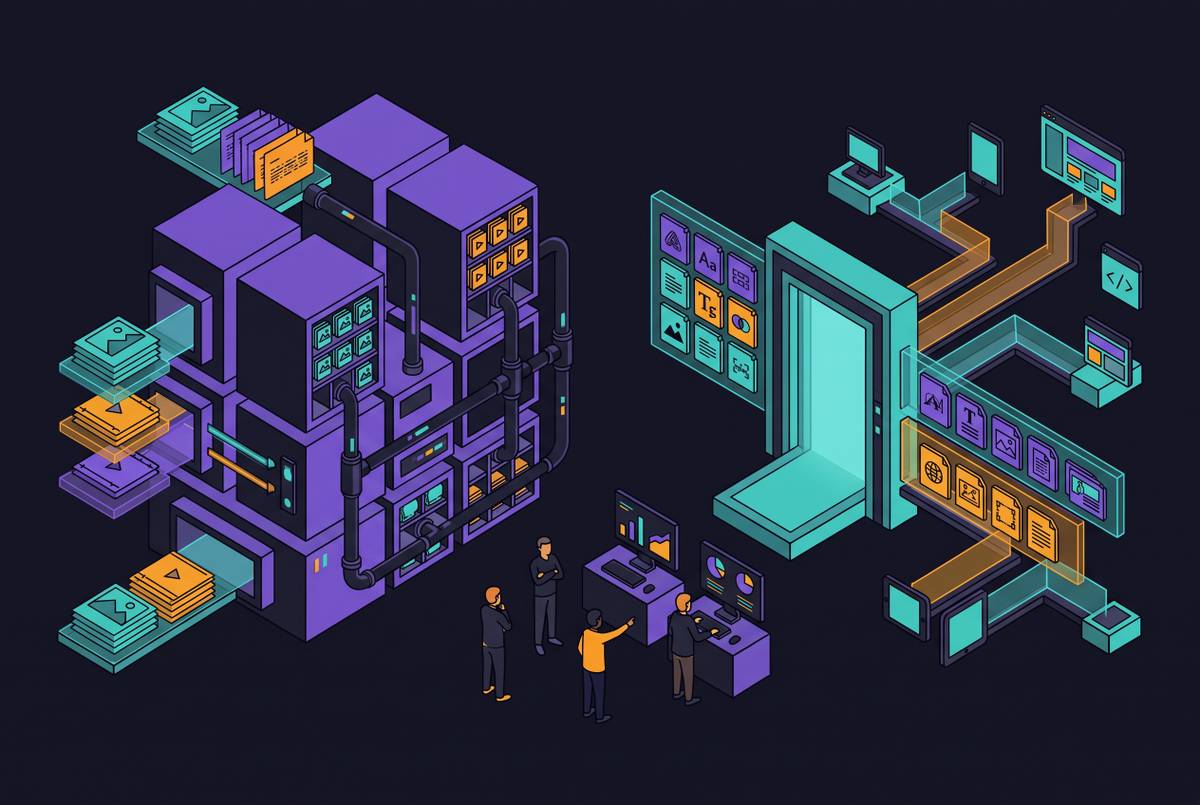
The Model Context Protocol, or MCP, gives any system a standardized way to describe its own capabilities so an AI agent can discover and call them without custom integration code written for each tool, and that protocol is the technical layer this runs on. Rainbrand uses that protocol to make brand context accessible to any MCP-compatible tool in a team's stack, the same way an MCP server built for a DAM makes its stored assets accessible to an agent. Positioned against a traditional DAM, Rainbrand isn't a file storage system, and it doesn't compete with one. It operates as the brand context layer above storage, making whatever assets a DAM holds usable by an AI agent in a way that stays consistently on-brand rather than requiring a human to check each output by hand.
Because of that distinction, you need to read every pricing model covered in this piece differently. A DAM's bill, whatever shape it takes, is a measure of storage, seats, downloads, or credits consumed. None of those numbers says anything about whether the brand content an AI agent produces from that storage will be usable the first time or will need a round of manual correction before it ships. That gap in what gets metered is the one a buyer has to account for separately, because no vendor's pricing page is going to flag it for them.